

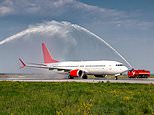
The bizarre reason planes get sprayed with water prior to take off has been revealed – and it has nothing to do with keeping the aircraft clean.
You’ve settled into the seat, favourite book in hand, and ready to hit the runway, when all of a sudden the plane feels as if it’s being bombarded with gallons of water. Odd, right?
Though one would assume the aircraft is undergoing a last-minute clean before it takes to the skies, the purpose for it being hosed down is, in fact, more ceremonial than it is practical.
A plane water salute is a celebratory ceremony that involves two fire engines spraying arcs of water over a plane, which creates a ‘tunnel’ for it to travel under.
Much like maritime salutes for ships, the custom, reserved for special occasions and landmark events, often serves as a gesture of respect, celebration or good luck.
Water salutes are performed for a number of reasons – though most notably to honour the final flight of a senior pilot or airport worker before retirement, according to Simple Flying.
They’re also staged when celebrating milestone events, such as the take-off or touchdown of a record-breaking flight, or to welcome the return of an Olympic team.
Sometimes, water salutes are carried out to honour military personnel, such as commemorating fallen soldiers.
A plane water salute involves two fire engines spraying arcs of water over a plane, essentially creating a ‘tunnel’ for it to pass through
The custom, which serves as a gesture of respect, celebration or good luck, is reserved for special occasions
They can also be performed when marking the first or last flight of an airline to a specific airport.
The water salute is said to have originated in the maritime industry, where fireboats would create a water arch for ships on their maiden voyages as a ceremonial welcome.
When planes were eventually introduced, the tradition was later adopted by the aviation industry, according to Schiphol Airport.
As reported by Simple Flying, there are unverified reports the first water salute took place in the 1990s at Salt Lake City International Airport to honour a retiring Delta Airlines pilot.
The water salute, a rare occurrence, is not to be confused with ground deicing, a common yet similar process of aircraft being sprayed with liquids prior to take off.
Many passengers might have experienced ground deicing before the aircraft starts to move, especially during cold weather, as it involves clearing and protecting plane surfaces from ice accumulation before taking flight.
Meanwhile, there’s one in-flight phenomenon that some would find a little more nauseating than most: the mysterious and messy reality of ‘blue ice’.
Blue ice occurs when frozen blocks of aircraft toilet waste break loose mid-flight and fall to the ground, sometimes causing property damage, injury and costly clean-up.
Water salutes are carried out to honour military personnel, or to acknowledge a pilot’s final flight before retirement
The water salute is said to have started in the maritime industry, before later being adopted in the aviation industry when planes were introduced
The term ‘blue ice’ refers to waste leaked from an aircraft lavatory system, mixed with blue disinfectant, which freezes at cruising altitudes where temperatures can plunge below –60 degrees Celsius.
Upon descent, the ice can dislodge and fall to the ground, sometimes with dangerous consequences.
Though modern aircraft waste systems are designed to be completely sealed and undergo regular inspection, small leaks – caused by hairline cracks or faulty seals – can occasionally occur.
These incidents are more common than many realise, with aviation experts at Brookfield Aviation highlighting them as one of the very real hazards of modern air travel.
Source link
CHECK OUT: Top Travel Destinations
READ MORE: Travel News