

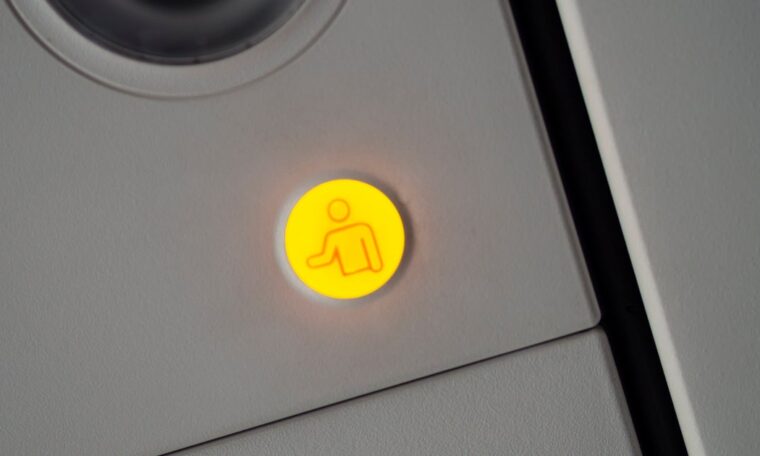
If you’ve ever hesitated before pressing the flight attendant call button on a plane, you’re not alone. Many travelers worry it’s rude, disruptive or off-limits unless there’s a true emergency.
In reality, however, that little button above your head exists for many reasons and can be a helpful tool for a smooth flight experience. But plenty of passengers use it incorrectly as well.
To help clear up any confusion, HuffPost asked flight attendants to break down exactly when you should press it and when you really shouldn’t.
When It’s OK To Ring The Call Button
“It’s uncomfortable to be poked, touched or lightly tapped, so ringing the flight attendant call button is often our preferred way to assist customers,” said Shannon Brown, a Detroit-based flight attendant with Delta Air Lines. “Customers should feel empowered to ring the call light for many different reasons, such as help with your seatbelt, clarity of announcements, the need for a beverage or snack, or even if they are just apprehensive or nervous during the flight.”
There are many common misconceptions around the call button, including that it’s exclusively for emergencies or that it annoys flight attendants. But the reality is that this feature is meant for any reasonable need that requires assistance from the flight crew.
“It’s absolutely appropriate to use the call button when you need something that affects your comfort, safety or well-being,” said Paula S. Adams, a Dubai-based former crew member for Etihad Airways, who is now a private flight attendant, and aviation and business trainer. “If you’re feeling unwell, have a concern about another passenger, need assistance with a seat issue or have a time-sensitive request, the call button is the right tool.”
She added that this tool is useful for situations when the aisle is blocked or a passenger is unable to get up due to a mobility issue, sleeping seatmate or lap infant.
“This applies to all customers, and especially those with disabilities: Please don’t hesitate to press your call light if you need assistance ― whether it’s getting to or from the lavatory, fastening your seatbelt, adjusting your seat, or anything else we can do to help you feel safe and comfortable,” said Benjamin Biffis, a Boston-based Delta flight attendant.
“With well over 100 customers on many of our flights, we may, on occasion, forget to bring you that soda refill that we told you we would get for you,” he added. “If it’s been a reasonable amount of time and we haven’t returned, please feel free to ring your call light to remind us!”
Catherine Falls Commercial via Getty Images
Some travelers worry that pressing the flight attendant call button is rude, disruptive or off-limits unless there’s a true emergency. But it’s more complicated than that.
Indeed, pressing that button is OK if the crew skipped your row during drink/snack service or you want to request something. If you need assistance with something related to your child or a disability-related issue, that’s also a totally fine reason. The same goes for passengers who are worried about a tight flight connection and seeking some guidance.
And in fact, you should let a flight attendant know about an issue that can potentially cause other problems.
“If you accidentally drop an item between seats, like earbuds or your phone, it’s important to notify a crew member,” a Delta spokesperson told HuffPost. “If the seat is reclined or otherwise adjusted, the device can be crushed. Not only is a damaged phone problematic, but damaged lithium batteries that power phones can also be a safety concern.”
She also noted that passengers can use the call button for a cabin comfort issue or safety concern.
“It’s fine to use the call button if something on your seat is broken, your reading light won’t turn off or your air vent isn’t working,” the spokesperson said. “Or if you or someone nearby is feeling unwell, faint or needs urgent help ― or if you notice something unusual.”
Of course, there are situations when flight attendants are unable to respond immediately, for instance during severe turbulence or safety checks, but someone will come to assist you as soon as it’s safe. So there’s no reason to worry about interrupting or annoying the crew with the call button if you have an issue.
“We don’t get annoyed when it’s used appropriately,” Adams said. “It’s part of our job, and in many cases, we prefer that you ring instead of trying to navigate a crowded or unstable cabin. We’d much rather you ring than struggle or wait in discomfort.”
She added that the call button actually helps reduce unnecessary passenger movement, keeps the aisles clear and prevents people from approaching areas where the crew might be conducting safety-related tasks.
“Airplanes can experience unexpected turbulence at any moment, the aisles are narrow, carts and service equipment can block your path, and there are times when passengers physically can’t or shouldn’t get up, whether because they’re strapped in, dealing with mobility limitations, or simply can’t move without disturbing others,” Adams said. “The call button allows you to request help without putting yourself at risk and without creating congestion in the aisle. It also prevents you from walking all the way to the galley, which can interrupt safety procedures, in-flight service or crew rest periods.”
In many cases, she added, pressing the call button can actually be the safer and more considerate choice. The important thing is to use this feature with purpose and allow the crew to follow the proper procedure for assisting passengers. Be polite and remember one press is sufficient.
“The courteous passenger is not the one who never asks for anything ― it’s the one who uses the call button respectfully and understands that sometimes the response might take a moment,” Adams noted.
When You Should Avoid Ringing The Call Button
“When moving on an active taxiway, taking off or in the final moments before landing after flight attendants have come through the cabin and completed their safety checks, please refrain from pressing your call light button unless it is an urgent matter that cannot wait to be addressed, e.g., a medical emergency,” Biffis said.
“The call button is a communication tool, not a concierge bell.”
“Pressing call lights during taxi, takeoff or landing for non-urgent requests ― like asking for a pair of headphones ― can put you and us at risk for unnecessary injury if we attempt to respond during these critical times when everyone should be seated for safety,” he explained.
Using the call button during these times for non-urgent matters is not just an inconvenience but an actual safety hazard for the crew.
“It’s unsafe for crew to be up when it’s turbulent or right after take off, so don’t ring the call light unless it’s an emergency when it’s bumpy or when the pilots ask flight attendants to take their seats,” said Heather Poole, a commercial flight attendant and the author of “Cruising Attitude: Tales of Crashpads, Crew Drama, and Crazy Passengers at 35,000 Feet.” “Water to take a pill, connecting flight information or the Wi-Fi not working doesn’t fall under emergency.”
In general, it’s best to wait until the seat belt sign is off to address those kinds of issues. And remember, the call button is not a fast-track to instant assistance.
“The call button is a communication tool, not a concierge bell,” Adams said. “It’s intended to signal a genuine need, not to bypass normal service flow, not to summon someone instantly and not to express frustration.”
Limit your use to actual needs and be patient with the crew.
“When it’s bumpy and the seatbelt sign is on, we may not answer a call light to stay safe and avoid injury,” Poole said. “The back of the plane is way bumpier than the front of the plane, so a passenger seated in the first row may not think things are that bad when in the back we’re quickly putting things away so we can take our seats and strap in.”
EThamPhoto via Getty Images
Understanding the role of a flight attendant can help you determine when to press the call button.
Keep in mind that the primary role of a flight attendant is to ensure customer safety, manage emergencies and enforce aviation regulations. Service is also part of the job, but that does not take priority over more serious issues.
“I can’t tell you how many times someone has rung a call light while the crew is dealing with a medical emergency just to ask for a drink,” Poole said. “That’s where I draw the line. I might also get annoyed at people who ring the light to hand me a tiny wadded up almost non-existent piece of trash, or to ask for a glass of water or a blanket five minutes after we’ve taken off and the plane is still climbing.”
She also said she doesn’t appreciate when passengers at the front of the cabin ring the call button to ask a flight attendant to remove the trash from their meal while the crew is still in the middle of serving meals to the passengers in the back.
“Have patience. We’re working as fast as we can,” Poole said.
The Delta spokesperson also advised against using the call button to ask what time you’ll land when that information is clearly available on the seatback screen and otherwise announced during the flight.
“It is not recommended to use the call button to complain about another passenger unless safety related,” she added. “Try to resolve minor annoyances quietly or wait until a crew member passes by.”
Avoid using the call button for matters you can handle on your own, like retrieving something from your bag in the overhead bin.
Adams also emphasized that passengers shouldn’t repeatedly use the call button for requests that the flight crew has already acknowledged or for things that are not in their control, like weather delays or seat upgrades.
“If it’s something that can reasonably wait a few minutes without affecting your comfort or safety, it’s considerate to hold off until the crew isn’t actively engaged in tasks that are essential to the operation of the flight,” Adams said, pointing to meal service and safety-related duties like securing the cabin for takeoff and landing, conducting compliance checks or following turbulence procedures.
“There are moments in the flight when the crew is required to stay focused on tasks that involve passenger safety or the flow of service,” she said. “During meal and beverage service, flight attendants are managing hot liquids, sharp objects, heavy carts and a very tight aisle ― all of which require our full attention to prevent spills, injuries or blocked pathways. Interrupting that work for something non-urgent, like an extra napkin or a drink refill, usually isn’t unsafe, but it does disrupt a process that’s designed to keep the cabin orderly and efficient.”
Ultimately, the call button is there to keep passengers safe, help them communicate with the crew and prevent unnecessary movement around the cabin. So if you truly need something, feel free to press it. But consider if your reason for using it actually aligns with what it’s for. And don’t forget to pack your patience for every flight.
Source link
CHECK OUT: Top Travel Destinations
READ MORE: Travel News