
Flying first class has long been considered the pinnacle of luxury when it comes to commercial travel.
From quieter cabins and fine dining to spacious seating – not to mention the feeling of being far removed from the rest of the plane – it’s a premium experience many travellers dream of, but only few can afford.
Yet what ‘first-class’ actually means today has changed dramatically since its debut on TWA’s Super Constellation New York to London route in 1955.
What began as a glamorous social affair for the wealthy in the 1960s evolved into a symbol of corporate power in the 1980s, and has now become a finely tuned product attainable for those with money to spare, or the right number of air miles or loyalty points.
In the ‘golden age’ of flying – the 50s and 60s – First Class passengers could expect hand-carved roasts, spacious lounge chairs, strict dress codes and glitzy cocktail bars that were designed to allow flyers to mingle with fellow flyers – all enjoyed with a cigarette in hand, of course.
How things have changed…today’s passengers, dressed more for comfort in their cashmere loungewear, settle into enclosed pods or private suites and browse Michelin-inspired menus as they pick out must-see movies to watch on their personal flatscreen TVs.
Though First Class has seen a number of advancements over the years, with modern cabins on airlines such as Emirates and Cathay Pacific now resembling miniature hotel rooms in the sky, some would argue the most regal class has lost its exclusivity and personal flair.
Here, we look at everything from price to service, and even the social etiquette of flying, and examine whether First Class has really evolved for the better – and ask whether it’s still worth the splurge…
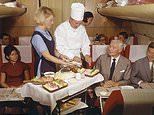
Caviar, sir? During the ‘golden age’ of flying – in the 1950s and 1960s, first class passengers could expect hand-carved roasts at 30,000ft…and the chance to enjoy a cigarette and a drink in the cocktail bar afterwards. Pictured: passengers onboard a Scandinavian Airlines flight in he 1950s
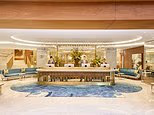
Flying First Class in 2025 is all about privacy – with flat-bed cocoons the norm on most airlines. Pictured: An Emirates First Class cabin
Ticket cost
In the 1950s and 60s, flying First Class was a very special privilege, with tickets from New York to London costing the equivalent of around £10,000 today.
Passengers typically using the premium service were generally the ultra-wealthy: diplomats, movie stars and business moguls, all dressed in their finest suits and most dazzling dresses.
By the 1980s and 90s, the rise of corporate travel meant going First Class became a status symbol for executives, with companies paying for premium fares as a way to showcase their success.
In recent years, loyalty schemes and upgrades have made the most luxurious seats more accessible – though prices remain high even with points or air miles.
A round-trip First Class fare from London to Singapore today, for example, can easily cost between £6,000 and £12,000, depending on the season and airline.
Service
In aviation’s golden age, service in first-class was almost theatrical.
In the 1950s to 1970s, passengers were treated to extravagant multi-course meals served on fine chinaware, with silver cutlery and linen tablecloths
In the 1950s to 1970s, passengers were treated to extravagant multi-course meals served on fine chinaware, with silver cutlery and linen tablecloths
In today’s era, service has become a more bespoke affair…with guests invited to escape to their own mini hotel rooms on board, complete with entertainment and fine dining tailored to individual tastes
Between the 1950s and the 1970s, passengers were treated to extravagant multi-course meals served on fine chinaware, with silver cutlery and linen tablecloths.
Flight attendants, who were impeccably groomed at all times, carved roasts by hand at passengers’ seats and poured champagne into crystal flutes.
In today’s era, service has become personalised and discreet, with a focus on subtle luxury rather than an elaborate show.
Airlines like Etihad, Japan Airlines and Singapore Airlines passengers are greeted by name and offered tailored experiences, such as private dining with onboard chefs.
Seating
The 1960s were undoubtedly the benchmark of in-flight socialising, with Pan Am’s 707 fleet and BOAC’s VC10s designed with wide reclining chairs and cocktail lounges where passengers mingled freely, according to Key Aero.
Sleek yet corporate seating took centre stage in the 1980s – defined by large, plush armchairs with leg rests and privacy dividers.
Although the first flat-beds came via British Airways in the mid 1990s, it wasn’t until the Noughties that the revolution of the lie-flat seat really arrived – and it quickly transformed long-haul luxury travel.
While First Class in the 1950s came with reclining seats, the dawn of the lie-flat bed was still four decades away
Now, the concept of a ‘seat’ in First Class is a thing of the past – flyers are more likely to find a fully enclosed suite with a sliding door – and even double beds for couples
First Class travellers can often adjust lighting, temperature and even the firmness of their mattress. Pictured: An Emirates Airbus A380 interior
Now, the concept of a ‘seat’ has almost disappeared, with first-class cabins on Etihad, Lufthansa, and Singapore Airlines offering fully enclosed suites, sliding doors, and even double beds for couples.
Passengers can adjust lighting, temperature and even the firmness of their mattress – a million miles away from the open lounge areas of the 1960s.
Amenities
In the 1960s, amenity kits were simple and practical, with carriers such as TWA gifting its highest paying passengers items such as shoe polish, perfume, combs, soap and hairspray.
By the 1990s, luxury brands such as Givenchy and Bulgari entered the mix with bespoke skincare and accessories, marking a new partnership between airlines and high fashion.
Today’s offerings on airlines such as Air France include fresh sets of Jacquemus pyjamasand Givenchy leather pouch bags packed with Clarins cosmetics, Biologique Recherche face cream, eye-masks and oshibori hand towels.
Luggage allowances and check-in
In the 1950s, luggage was a statement of status, and passengers would typically board their flights with monogrammed steamer trunks or ‘dress-suit cases.’
Pictured: An interior view of the First Class compartment of a commercial passenger plane in the 1950s
Emirates Airlines unveiled its First Class individual cabin back in April 2004 at the Grand Hyatt Hotel in New York City
Restroom chic: A luxury First Class bathroom with shower onboard of Emirates Airlines Airbus A380 upper deck in 2024
Though no formal baggage limits were specified during that time, passengers often arrived with minimal luggage as early planes had limited overall capacity.
By the 1980s, airline alliances introduced priority baggage handling, and premium travellers enjoyed the first dedicated First Class check-in counters.
Fast forward to the 21st century, and first-class passengers can check in from private areas of the terminal, use chauffeur-driven transfers, and track their luggage via apps and devices.
Allowances have also expanded – from one or two suitcases to allowances of up to 50kg in First Class on specific Emirates flights, provided no single bag exceeds 32 kg.
Rules and restrictions
The 1950s to 1970s were a famously indulgent time for those lucky enough to be turning left on the plane.
Flyers could smoke cigarettes, cigars and even pipes onboard, while alcohol – included in the ticket fare – flowed abundantly.
Dress codes were strictly formal, with men in suits and women in cocktail dresses or heels.
In its early decades, First Class was all about socialising, with in-flight lounges doubling up as cocktail bars in the clouds
Now, privacy rules, with fully enclosed suites, quiet cabins, and digital entertainment discouraging mingling and general interaction
In the 1950s to the 1970s, dress codes were strictly formal, with men in suits and women in cocktail dresses or heels. Pictured: Vintage photos show Scandinavian Airline passengers being served lobster, caviar and cream cakes during the golden age of flying
Something to drink? An Emirates Airbus A380 onboard lounge and bar in 2017
By the 1980s, smoking was still common but beginning to fade under public health pressure. Dress codes softened as travel became more routine, though first class retained its formality.
Smoking is banned entirely on commercial planes, and formal wear has been swapped for comfort, with passengers often boarding in designer loungewear.
Social Etiquette
In its early decades, First Class all about who you met along the journey, with in-flight lounges doubling up as social clubs in the clouds.
While Pan Am’s upper decks hosted cocktail parties, airlines like Qantas and BOAC even installed pianos for onboard entertainment.
By the 1980s, the glitz, glamour and boozy banter was replaced by ambition and productivity, with the most expensive cabin becoming networking spaces for executives and entrepreneurs finalising deals mid-flight.
Modern First Class is all about privacy and seclusion, where fully enclosed suites, quiet cabins, and digital entertainment discourages mingling and general interaction, though communal bars exist for those after a change of scenery during a long flight.
Passengers – especially those travelling alone – rarely chat with strangers; instead, they close their suite doors, recline their beds, and escape into solitude.
Source link
CHECK OUT: Top Travel Destinations
READ MORE: Travel News