

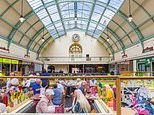
The north of England is renowned for its vibrant indoor markets, one-stop spots for everything from fresh produce and locally-sourced meats to beauty salons and travel agents.
Each one is bustling with historic charm and diverse independent traders, with Leeds Kirkgate Market and Grainger Market in Newcastle being among the most well known.
Grainger Market dates back to the Victorian age, opening in October 1835 as part of Richard Grainger’s major redevelopment of Newcastle city centre.
It was considered one of the most modern indoor markets in Europe at the time and remains a significant example of Victorian architecture, with its ironwork and glass roof.
Almost two centuries after it was first built, the market at the heart of Newcastle city centre continues to be a popular spot with more than 100 businesses under its roof.
And now, thanks to a £9 million Levelling Up Fund investment, the Grade I-listed building is set to be transformed into a destination to rival the best of Europe’s indoor markets, according to Newcastle City Council.
Work includes the construction of an upstairs pavilion and new flooring, toilets, doors and seating, which should make the market capable of hosting gigs and plays.
The project was originally due to be completed last summer, but is now expected to end early this year.
Almost two centuries after Grainger Market was built, it continues to be a popular spot with more than 100 businesses under its roof
Thanks to a £9 million Levelling Up Fund investment, the Grade I-listed building is set to be transformed into a destination to rival the best of Europe’s indoor markets
Grainger Market dates back to the Victorian age, opening in October 1835 as part of Richard Grainger’s major redevelopment of Newcastle city centre
The redevelopments also include filling in air raid shelters, built as tunnels beneath the market arcade around 1941, which were deemed impractical to preserve.
The shelters were determined to be in a significantly deteriorated and unsafe condition, leading the council to propose filling them with concrete as part of the refurbishment plan.
In recent years, some of the tunnels have been accessed by the public as part of Heritage Open Days, although that stopped in 2018.
Among the most popular businesses in the market is the world’s smallest Marks and Spencer’s store, the last surviving example of the Penny Bazaar shops, which gave birth to the well-known Marks and Spencer’s chain.
The market is also home to Britain’s oldest family-run pet store, Robinson’s Pet Store, now run by the third generation of the Robinson family.
On TripAdvisor, Grainger Market ranks 14th out of more than 300 things to do in Newcastle and has an overall ranking of 4.4 stars.
One review reads: ‘Loved wandering around Grainger Market! Such a lively place with so much character. It’s not fancy, but it feels authentic and full of charm – definitely a spot to experience the real Newcastle vibe.’
Another recent reviewer wrote: ‘It’s a thriving, proper local market with something for everyone. It covers the staples of meat, veg and sundries, home essentials, but also many British and international food options.’
On TripAdvisor, Grainger Market ranks 14th out of more than 300 things to do in Newcastle
This store is the last surviving example of the Penny Bazaar shops that founded the Marks & Spencer chain of stores
Newcastle is set to compete with the likes of Riga Central Market in Latvia, which is often cited as Europe’s largest market by area and stands in reused Zeppelin hangars.
Turin’s Porta Palazzo is known as Europe’s largest outdoor market, a vast, bustling hub for fresh produce and more.
Closer to home, in 2024, Sheffield became home to Europe’s largest purpose-built food hall, Cambridge Street Collective.
Located in Sheffield city centre, the industrial venue is around 20,000 sq ft and was designed to create a prime social and communal destination.
Source link
CHECK OUT: Top Travel Destinations
READ MORE: Travel News