

It’s been ten years since Steve Sangster pulled over after spotting a roadside sign advertising the sale of Billet Wood, a small woodland near Dartford in Kent.
Little did he know then that his initial aim when he thought about buying it – that it might save him money on firewood – would be quickly displaced by something far more meaningful.
Steve, 43, who lives in Orpington with his wife and their four young children, originally bought the four-acre woodland as a financial investment – with the added bonus of securing a steady supply of logs.
Via Woodlands.co.uk, the family paid £45,000 for Billet Wood a decade ago – just over £11,000 per acre.
Today, similar plots can cost £20,000 per acre of more, driven by rising land prices, demand for amenity woodlands and a post-pandemic desire to reconnect with nature.
Though he initially approached the purchase with a commercial mindset, Steve now admits it no longer feels like an investment in the traditional sense.
The woodland has become a sanctuary, a personal campsite that’s a place of learning, nurturing and quality family time – a welcome escape for Steve, a banker who spends the other portion of his life roaming the concrete jungle of London’s Canary Wharf.
Speaking to the Daily Mail, he jokes: ‘It turned out to be a really bad investment over over time, because, actually, we love it so much for other reasons now, but we’d never sell it.
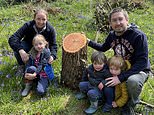
Steve Sangster, 43, who lives in Orpington with his wife and their four young children, purchased a four-acre woodland as a financial investment ten years ago
Over the years, Billet Wood has become a place of learning, nurturing and quality time for Steve and his family
‘So it’s an investment that that’s going to always be there, but we get a huge amount of value in other ways.’
Over the years, the family has actively managed the land, investing in coppicing (an ancient management technique that involves cutting trees to their stumps), improving biodiversity and planting native trees such as oak and birch.
By selectively cutting sweet chestnut, which grows in abundance across the wood, sunlight has returned to the forest floor, triggering an explosion of bluebells, foxgloves and wildlife – from badgers and birds of prey to insects of all varieties.
The father-of-four says: ‘It woke up the seed bed that had been dormant there for decades.
‘And my God, the bluebells and foxgloves that came up in the spot were incredible.
‘With that comes all the other life that goes with it, in terms of the insects, birds and the animals. I’ve even seen newts in the garden here.’
As for maintaining the woodland, Steve says although constant labour is not required, careful management is important over time to prevent overcrowding and disease.
Training, safety and bio-security have all been part of the learning curve, as Steve explains: ‘The woods can be left for years – decades – without problems. But without proper management, disease can set in.
‘Trees can become quite crowded and dark, and when light’s not coming in, it impacts the amount of flora that’s around on the woodland floor, which then impacts the other species that rely on that.
Steve initially approached the woodland as a financial investment – a way to fund a loft conversation and secure a steady supply of logs
Since taking ownership of the wood, the family has actively managed the land by investing in coppicing – a management technique that involves cutting trees down to their stumps
Steve said: ‘You’ve got the whole wood to explore. The kids will be making bird boxes, observing the nature – it’s somewhere to go’
‘So I guess you don’t need to be a lumberjack from day one, but certainly after ten years, you’ve got to start to think about: what does this wood need from me?’
Once Steve began pouring love into the woodland, unexpected benefits followed.
The now-keen nature photographer began sharing sharing pictures and videos of the Billet Wood on social media, eventually attracting a large following.
Footage of wildlife – including badger cubs emerging among bluebells – led to the woodland being featured on BBC’s Wild Isles, presented by Sir David Attenborough.
THREE ENGLISH WOODS FOR SALE
A piece of woodland to call your own: Leader Copse in Hampshire is currently on the market for £145,000
Leader Copse, Hampshire: £145,000
‘A delightful mixed woodland consisting principally of western red cedar and some fine mature broad leaf trees; nestling in the attractive landscape of rural Hampshire.’
Haulton Wood, Wrexham: £45,000
‘Flat, well drained woodland full of wildlife, in a quiet location 15 minutes from Whitchurch. The woodland is in its infancy and can be gently shaped to be whatever a new owner choses.’
Great Hart Wood, Ipswich: £69,000
‘An attractive established woodland close to Ipswich with excellent access.’
However, there are a number of limitations to woodland ownership, Steve says.
Development on the land is restricted, and overnight stays are capped at 28 days a year.
The family now uses a modest caravan as a ‘holiday home away from home’ instead of taking weekend breaks elsewhere – allowing them to forage, go on family walks, observe wildlife, enjoy a meal around a campfire, and gather materials for crafts.
Steve explains: ‘You’ve got the whole wood to explore. The kids will be making bird boxes, observing the nature – it’s somewhere to go.
The family stay in a modest caravan or set up tents in the woodland as a ‘holiday home away from home’ instead of taking expensive weekend trips elsewhere
The family now spend quality time together foraging, going on nature walks, observing wildlife, or enjoying a meal around a campfire
According to Steve, selling is no longer an option as it’s become a deeply personal possession – despite the woodland increasing in financial value over the years
‘It’s probably saved a lot on weekends away, because I can take the caravan down there, and we can treat it as a bit of a break with the wood being 45 minutes away. It takes us into a new area.’
Concerns such as disease, ticks, storms and even wild boar come with the territory, but Steve sees many challenges as beneficial.
According to the banker, deadwood and fallen trees caused by storms help regenerate the woodland, encouraging new growth and supporting ecosystems that have evolved over thousands of years.
The wood has also supplied materials for new decking in Steve’s garden, as well as going toward community projects such as a woodland cinema screen, a fire beacon and even a community Christmas tree – saving money and reducing waste.
While the woodland has increased in value, Steve says selling is no longer an option, as it’s become a deeply personal possession that holds memories, milestones – and even the ashes of loved ones.
He said: ‘It delivers so much value to us, we wouldn’t want to sell it. For example, we keep chickens here. They get buried there.
Steve and his family now enjoy a range of benefits – including better physical and mental health and a chance to enjoy ‘staycations’ as a family without the high costs
‘And then we’ve had elderly relatives that have asked us to scatter their ashes. So then it starts becoming a little permanent in its outlook.’
For Steve and his family, the benefits are clear: physical work instead of gym sessions, a mental escape from demanding jobs, a chance to enjoy ‘staycations’ without the hefty price tag and a strong connection to the natural world.
His advice to others considering woodland ownership? ‘I’d really recommend it to others’, Steve says, ‘It costs less than some of these alternatives, like second homes, or parks, where you get tied into paying.
‘Woodlands are where mankind originated from. The country was covered, and we lived within it originally, and it feels so much more at home going into the woods.’
Source link
CHECK OUT: Top Travel Destinations
READ MORE: Travel News