

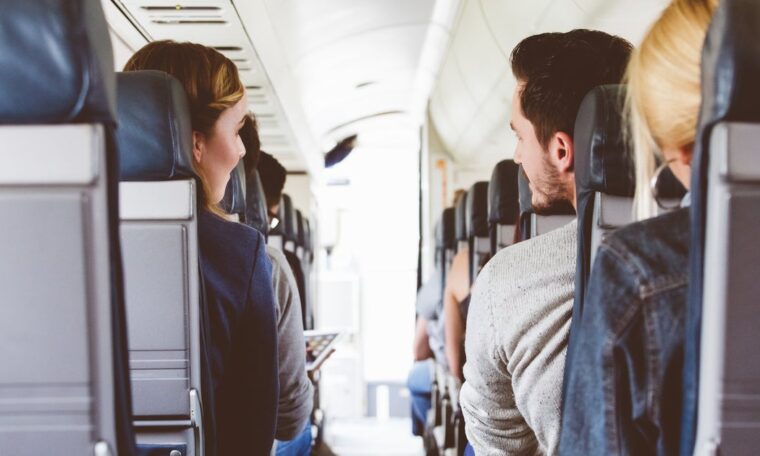
The man in seat 42E looks confused. I’ve just leaned across and asked him to pass my water bottle to “that woman” in 42F. He glances at my wife, Cece, then back at me, piecing it together.
“Do you want to switch seats?” he asks, already half-standing. We’re barely five minutes into a long-haul Melbourne to Dallas flight. We politely decline, and he settles back in, uncertain.
We’ve been doing a “seat divorce” on flights for several years. Cece prefers an aisle seat. So do I. Rather than one of us suffering in the middle, we stopped sitting together. Sometimes we’re in the same row with a stranger between us. Sometimes Cece is a few rows away. Either way, a few hours in, we meet in the aisle for a few minutes, then head back to our separate seats. And we’re not the only couple doing this.
Alexa Moore and her husband are both tall and hate middle seats. After years of taking turns in the middle, they quit pretending it was fine. Now they book aisle seats and let strangers fill the gap.
On a flight to St. Croix last year, the woman between them asked five times if Moore wanted to switch. “She thought she was about to benefit from my exit row aisle seat,” Moore said. “I shut it down very fast.”
But the impulse to intervene goes deeper than one opportunistic seatmate. Tawanna Marie Woolfolk, a licensed clinical social worker, said that reaction is revealing.
“We’ve been culturally conditioned to equate visible proximity with relational health. Sitting side by side becomes shorthand for ‘we’re good,’” Woolfolk explained. When a couple chooses space, she said, separation gets interpreted as conflict. “That says less about the couple and more about our collective discomfort with intimacy that doesn’t perform itself on demand.”
The Moores wake each other from across the aisle when snacks arrive. When they land, there’s no dramatic reunion. “It kinda feels like we didn’t spend time apart because we had the shared experience of being on the flight,” Moore said.
Could your relationship benefit from a “seat divorce” when traveling? Experts say there are some perks.
That seamless feeling is the point, according to Dan Auerbach, an emotionally focused therapist who leads a practice of more than 40 psychologists and relationship therapists.
“Connection is often stronger when it’s chosen, not just continuous,” he said. “Sitting side by side for many hours can fade into background noise. Choosing to walk toward each other, swap movie picks, share a quick laugh, that’s intentional connection.”
Some couples have turned the separation into a system. Natalie Houston and her husband have taken hundreds of flights together in the past two years. She needs the left aisle so her elbow has room while she edits videos. Matt wants the window. Even after 260 flights, he still watches takeoff like it’s his first, she said.
Their ideal setup is window and aisle in the same row, middle seat empty. When that doesn’t work, they take two aisles and text each other throughout the flight. “What entrée did you order?” “What are you watching?” “Want to start the same movie at the same time?”
“We’re fully functioning adults who text each other from 18 inches away,” Houston said. “It’s ridiculous. And efficient.”
Once, flying standby, they got the last two seats on a long-haul flight, nowhere near each other. Houston boarded last and found herself in a middle seat between a married couple who’d settled in. There were things in her seat. Hope in their eyes. She offered to let them sit together. “No, no,” they both said at the same time.
The whole flight, they passed things over her. Whisper-yelling about chargers. Asking each other what they ordered for dinner.
“I thought, OK, I get it. My husband and I do the same thing,” Houston recalled. “But what they didn’t get was, we plan for this. I slept through most of it, so I survived. I think they did not, though. If you’re going to do this, you really need a system.”
The seat divorce started by accident for Veronika Romane. She and her husband used to skip seat selection to save money and kept ending up in different rows. “Over time, we both realized that we actually preferred sitting apart on most flights,” she explained.
Now they sit one row apart, both in window seats. Her husband leans back to pass her cookies midflight. She calls him a “determined snack smuggler.” A flight attendant once joked they must be “either happily married or currently in a very polite argument.”
The arrangement isn’t rigid. When their dog passed away, they deliberately sat together on the next two trips. “It helped us be there for each other,” Romane said.
By hour 14 on a long-haul flight, most people are exhausted. You’re not at your most patient, and sitting next to anyone that long can start to feel like a lot.
“Under stress, closeness can shift from connection to obligation,” Woolfolk explained. “Instead of co-regulating, partners may end up co-enduring, maintaining an image of intimacy rather than experiencing it.”
Not everyone is convinced of the effectiveness of a seat divorce, however. After 30 years of clinical work, social worker Stacy Pelletieri sees a potential red flag.
“You do not have the row to yourself either way. You’re with strangers,” she pointed out. “So, if you’re choosing strangers over your spouse simply because you need space, this speaks to the inability to get space from your partner unless you are physically apart.”
She describes sitting next to her husband on long flights, each absorbed in their own movie or book, still enjoying the closeness. They hold hands during turbulence. “In healthy relationships, you can be sitting right next to your partner and still have a boundary when needed,” she said. “Being able to say, ‘I’m going to read a book now.’ To be physically close but still do your own thing.” She concedes that if both people genuinely just want an aisle seat, it may simply be a preference and nothing more.
Auerbach is less concerned. “Not every practical decision is a psychological statement,” he said. “If both want a window seat and neither feels slighted, it’s probably just good back care.”
Halfway through our flight, Cece and I reconnect at the galley. We swap notes on movies, grumble about not sleeping and grab a snack from the flight attendant before returning to our seats. When we land in Dallas, 17 hours apart, we’re not worn down or irritable. We’re glad to see each other.
“We survived another long flight,” I tell her. Cece nods.
Our seat divorce works every time.
Source link
CHECK OUT: Top Travel Destinations
READ MORE: Travel News