

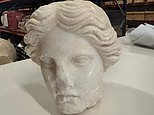
A marble head dating back some 2,000 years has been discovered at a Spanish beach – and it’s said to be one of the most significant Roman-era sculptural finds in the region.
The historic find was made during ongoing regeneration work on Alicante’s popular Almadraba beach.
Workmen who stumbled across the lump of marble were left amazed when experts were called to the scene, who later revealed the head dates back to the High Imperial Roman period in the first or second century.
The white marble head, which archaeologists say may possibly represent the goddess Venus, is still in near-perfect condition, aside from minor damage to the nose.
Its cultural and historical value is said to be incalculable.
Alicante council describes the bust as ‘a Roman head of great artistic quality and in excellent state of preservation’, while archaeologists already consider it one of the most substantial finds in Alicante from the Roman era.
Councillor for culture, Nayma Beldjilali, added: ‘We could be talking about one of the most important Roman sculpture finds in the history of Alicante and the province.
Regeneration work at La Almadraba beach is currently being put on hold while a full excavation is carried out.
A marble head estimated to date back to he High Imperial Roman period in the first or second century has been discovered at Almadraba beach in Alicante
Pictured: Almadraba Beach in Alicante, which has been going through regeneration work
The white marble head is still in near-perfect condition, aside from minor damage to the nose
The site has been designated as an archaeological area for over 15 years after the remains of a Roman villa linked to Lucentum was discovered in 2009.
Speaking of the villa, Mr Beldjilali added: ‘It must have been the home of some prominent Roman citizen.’
As for the newly-discovered head, which measures 22.22 centimetres high and 19.78 wide, experts believe it could have once been placed on a base in Roman patrician houses – though tests are set to be carried out to confirm this.
José Manuel Pérez Burgos, head of integral heritage, said: ‘The bust presents a hairstyle of Hellenistic influence, with wavy hair pulled back with a parting in the middle following the idealised model of representations of divinities such as the Greek Aphrodite or the Roman Venus.’
‘The time of Emperor Caesar Augustus, between the year 27 BC and the 19th of the current era, meant a strong expansion of the borders of the Roman Empire and brought the Pax Romana and a time of great cultural effervescence.
‘In this context the goddess Venus was considered in the Empire the mother of the Roman people and represented love, beauty and fertility.’
The cultural department added: ‘This era was operational between the third century BC and fourth century AD.
‘As a result of these works, foundations of houses and rooms belonging to a Roman villa of a maritime nature have been found, abundant remains of ceramics, some of them very well preserved, and coins of the time.’
The beach was scheduled to reopen in time for peak summer season, though this has now been delayed due to the find.
Share or comment on this article:
Tourists stunned as 2,000-year-old Roman marble head of Venus dug up on popular Spanish beach
Source link
CHECK OUT: Top Travel Destinations
READ MORE: Travel News