

A chill slinks up my spine. The last trace of sunset has sloped below the horizon, and now all eyes are on the vast, velvet sky.
Above me, a dusting of stars flickers to life, and constellations sharpen into focus. My gloved hands clasp a hot chocolate, steam curling into the cold air. Even wearing a beanie hat, with a rug wrapped around me, I shiver.
It isn’t what most imagine when they dream of Hawaii – a fantasy land of leis, swaying palms, and sun on skin.
But this perch, nearly 14,000ft above sea level near the summit of Mauna Kea on Hawaii itself confirms what my nine-day journey across islands has shown: this archipelago, culturally and geographically complex, is much more than a simple beach destination.
But the realisation comes in hindsight. When I first arrive in Honolulu, on the island of Oahu, my expectations (and hopes) are of tropical beaches and little more.
My hotel, Romer House, is a 10-minute walk from the famous Waikiki Beach – a shoreline known for postcard sunsets and long, consistent waves.
But this is also where the myth of Hawaii collides with an urban reality of high-rise hotels designed for mass tourism.
A nine-day journey reveals the many ways in which the archipelago defies its stereotypes
Replace beaches with a trek dormant volcanoes on the island of Hawaii
Start to head inland, though, and the tone shifts. Downtown, Iolani Palace is a regal addition to an otherwise unassuming patch of city.
This grand building was the seat of Hawaii’s monarchy until 1893, when Queen Lili’uokalani was overthrown by a provisional government that paved the way for annexation by the US.
Inside, you’ll find rooms restored with period furniture, from gilded mirrors to grand portraits of monarchs.
Among traditional artefacts, such as ‘ahu ‘ula feather cloaks, are silky robes, and military-style uniform – much of the place feels like a British court in the Victorian era, not a spit of land in the Pacific.
This is no accident: the Hawaiian monarchy cultivated close ties with Britain, adopting our ceremonial fashion and court etiquette to assert itself as a modern sovereign state.
That fascinating, unexpected relationship can be seen interwoven in modern Hawaii; the state flag features the Union Jack.
Visitors to Honolulu, Oahu, can head downtown to the Iolani Palace, where close ties between the Hawaiian and British monarchy can be keenly felt
But if you do want the coast – and of course you do – swap the crowded strip for the North Shore, a 40-minute drive from Honolulu. Wooden homes and little boutiques sit back from the road, and food trucks replace breakfast buffets. In winter, the area draws the best surfers to breaks like Pipeline.
Taking local advice, I order a shave ice to ease the heat – a Hawaiian staple made from ice finely shaved, then drizzled in fruit syrups. If you’re in the quaint town of Hale’iwa, order from Matsumoto Shave Ice, slinging ‘snow’ for 75 years.
The drive back to the capital reveals even more of the island away from the coast.
On the windward edge, I stop at Kualoa Ranch, a dramatic 4,000-acre patch of land that rises into steep valleys.
Many will have seen this working ranch on the screen: it stood in for prehistoric worlds in Jurassic Park, a fantasy world in Jumanji, and a war zone in Lost.
‘Many visitors to the islands only scratch the surface of this special place,’ says Noah ‘Keola’ Ryan from North Shore Eco Tours.
‘Malihini (visitors) can discover so much more if they dare to look beyond the tourist attractions and seek out knowledgeable kama’aina (locals).’
This feels even more true on the main island of Hawaii, which gets significantly fewer tourists than Oahu and Maui, and feels less curated.
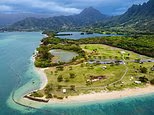
For those after a chance to explore Hawaii’s magnificent beaches, venture to the North Shore on Oahu, a 40-minute drive from Honolulu
Many come here for Hawaii Volcanoes National Park, home to two active volcanoes: Kilauea and Mauna Loa. On my visit, there’s no lava in sight. Instead, steam rises from cracks in the miles-wide crater, as if the island is breathing.
The coast does have its place on a holiday here. Punalu’u Beach isn’t the golden sand stereotype, but black and granular, a legacy of cooled lava flows. It’s a site for green sea turtles, which lounge by the water, mottled shells catching the light.
And despite its reputation for sun-kissed days, another incredible experience in Hawaii is nocturnal.
After darkness falls on Kailua-Kona, on the west coast, I join a group in canoes, paddling out into the water to lights fixed beneath the waves. Snorkel on, I slip beneath the surface, holding still as manta rays spanning several meters circle above me.
From under the water to higher than the clouds, Hawaii exceeds expectations. I saw only two of the 130-plus islands – a little hole to heaven, as Oahu-based musician Jack Johnson might say.
It’s a long slog to reach from the UK but once you’re there – whether foot in sand or spying the stars – it’s a destination to savour.
TRAVEL FACTS
Oahu
Romer House (from £184; romerhotels.com) in Honolulu is an uber cool, contemporary hang out close to Waikiki Beach.
For something straightforward and comfortable in the north-east, book Courtyard by Marriott Oahu North Shore (£296; marriott.com).
Hawaii
Pick Volcano House (from £71; hawaiivolcanohouse.com) if you want to stay as close to the active volcano as possible.
For a fun, casual holiday vibe, plump for OUTRIGGER Kona Resort & Spa (from £257; outrigger.com) on Hawaii’s western shore.
For more information, visit gohawaii.com
Source link
CHECK OUT: Top Travel Destinations
READ MORE: Travel News