
The UK’s largest train operator has been brought into public ownership – but what does the move mean for the millions of passengers who rely on its services?
On Sunday, 31 May, Govia Thameslink Railway (GTR), which runs Thameslink, Southern, Great Northern and Gatwick Express services, officially came under Department for Transport (DfT) control.
Transport Secretary Heidi Alexander hailed the shift ‘a defining moment in our reform of the railway’.
GTR is the busiest train operator in the country, carrying more passengers than any other operator, accounting for around one in six rail journeys made in Britain.
The change forms part of the government’s wider plans for rail reform, which will see Great British Railways (GBR) take responsibility for both tracks and trains under a single public body for the first time since privatisation in the mid-1990s.
All passenger services are expected to be brought under GBR by the end of 2027.
Ministers have pledged a range of improvements, including a crackdown on graffiti in Thameslink train toilets, signalling upgrades between Farringdon and Blackfriars to help cut delays, and 110 new travel safe officers to tackle anti-social behaviour.
But as public ownership begins, passengers can expect to see some big changes – as we reveal below…
Govia Thameslink Railway (GTR), which runs Thameslink, Southern, Great Northern and Gatwick Express services, was brought into public ownership on Sunday, 31 May
Will train services improve?
Not immediately, but passengers should begin to see some changes over the coming months.
Weekday services will initially see a temporary reduction of around two per cent between 18 July and 29 August, when passenger numbers are typically lower during the school summer holidays.
However, extra services are planned on a number of routes, including those serving East Grinstead and Gatwick Airport.
From December, the Department for Transport says Gatwick Express services between London Victoria and Gatwick Airport will run twice as often, while additional Great Northern services will operate between Moorgate and Hertford North.
Will tickets cost more?
No. The government has confirmed rail fares will remain frozen until March 2027.
Existing compensation schemes, including Delay Repay for delays of 15 minutes or more, will also remain in place.
Transport Secretary Heidi Alexander (R) speaks with train driver Kate Wilcox at Brighton Station on May 21, 2026 in Brighton, England
Will trains look different?
For now, no. Most services will continue operating under their current branding, although the first Southern train carrying Great British Railways branding was unveiled in Brighton earlier this month.
New colours and branding are expected to be rolled out gradually as operators transfer into public ownership.
Which operators have already transferred?
GTR is one of several operators now under public control. LNER, Northern, Southeastern and TransPennine Express were already publicly owned before Labour took office.
Since then, c2c, Greater Anglia, South Western Railway and West Midlands Trains have also transferred.
Chiltern Railways is due to follow on 20 September, with Great Western Railway transferring on 13 December.
Will every train service be publicly owned?
No. While most passenger operators will eventually come under Great British Railways, some open-access operators, such as Lumo, will continue to run services in the private sector.
Rail freight companies and rolling stock leasing firms will also remain privately owned.
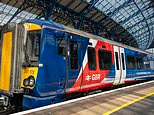
The Department for Transport is introducing the new, red, white, and blue Great British Railways (GBR) livery across the national network
Why is the government doing this?
Labour pledged to bring train operators into public ownership as contracts expired, arguing that a more integrated railway would improve reliability, reduce cancellations and deliver better value for passengers.
Ministers have also promised cleaner trains, upgraded onboard WiFi and closer cooperation between train operators and Network Rail.
What happens to railway staff?
Around 8,000 members of staff will transfer to the government’s train operating company.
The Department for Transport has said staff will keep their existing pay, terms and conditions as part of the move.
What is Great British Railways?
Great British Railways (GBR) will be the new organisation responsible for overseeing both train services and railway infrastructure.
The body is intended to bring tracks and trains under one organisation for the first time since rail privatisation in the 1990s, with the full transition to public ownership expected to be completed by the end of 2027.
Source link
CHECK OUT: Top Travel Destinations
READ MORE: Travel News