

Some of us spend months saving for one, while others are happy to flex the Amex and book a night away at a moment’s notice – but according to experts, the hotel you choose when travelling can reveal a lot about what makes you tick.
From a flashy big-name brand hotel to a genuinely practical, affordable alternative, your overnight establishment of choice says more about your personality than you might think.
Speaking to the Daily Mail, a range of experts from across the hotel industry have shared the secret significance of your booking habits, whether you’re a tried-and-tested Travelodge fanatic or a pursuer of niche boutique stays.
McLean Robbins, founder of Lily Pond Luxury, has a wealth of experience in the travel industry – here, she spotlights the significance of each type of booking
Regardless of your budget and priorities, there’s a hotel out there that best represents what you stand for.
McLean Robbins, founder of travel advisory company Lily Pond Luxury, has weighed in on what hotel choice says about travellers.
She told the Daily Mail: ‘Hotel choice is one of the clearest tells in travel. It often reveals far more than budget.
‘It shows how much uncertainty a traveller can tolerate, whether they value status or subtlety, and whether they want to be impressed, looked after, left alone, or surprised.
‘The biggest mistake people make is assuming the most expensive hotel is automatically the smartest choice. Sometimes it is. But often, the best hotel is not the one with the biggest name. It is the one that fits the traveller, the destination, and the type of trip they are actually taking.’
Read on to discover which one best encapsulates your personality – and if it’s hopelessly naff or unexpectedly chic…
All-inclusive resorts – flop, drop and nothing to pay for
A favourite of families, all-inclusive hotels show no signs of slowing down
The all-inclusive – paradise to some, hell to others. Package holidays (23 per cent) and all-inclusive breaks (22 per cent) are among the holiday types people feel most confident booking this year, unsurprising given the ongoing conflict in the Middle East and its impact on jet fuel prices.
New research from Co-op Holidays has found holidaymakers are prioritising convenience and simplicity when planning their trips, with traditional package holidays and connected European breaks topping their lists.
By contrast, independently planned or complex itineraries are currently less appealing, with just 11 per cent saying they feel most confident booking flights and accommodation separately.
THE EXPERT VERDICT
McLean says: ‘The standard all-inclusive guest is often a family, a group, or a high-performing professional who wants ease, containment, and no mental maths. It is less about being unsophisticated and more about being exhausted.
‘The smartest all-inclusives are not necessarily the cheapest ones. The best value is when the inclusions are things you would actually use, like excellent dining, kids’ clubs, transfers, activities, wellness, water sports, or guiding.
‘The worst value is when you are paying for unlimited everything but only want a beautiful room and one good dinner a night.’
B&Bs – for travellers who want a story
B&Bs are small, cosy places to stay, often with only a few rooms
The idea of a typical B&B might conjure up images of cosy cottages run by elderly couples and with a warm vibe.
But they are becoming increasingly chic – and are not just for older travellers on a budget.
THE EXPERT VERDICT
McLean says: ‘B&Bs and inns appeal to travellers who want warmth, intimacy, and character. This guest is often looking for a story rather than a spectacle.
‘A B&B choice can say you value personal connection and a sense of place over amenities. You may not need a spa, a lobby scene, or six restaurants if what you really want is a charming room, a good breakfast, and a host who tells you where to have dinner.
‘They can be excellent value, particularly in countryside, coastal, or small-town destinations where the hotel scene is limited. But they are not for everyone. If you want anonymity, room service, air conditioning guaranteed to the degree, and someone to bring a martini at 11 pm, a B&B may not be your love language.’
Budget brands – for the smart booker
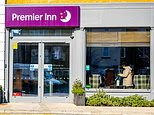
Budget brands are often household names, such as popular Premier Inn
Some associate them with a last-minute airport hotel stay – but for others, these budget properties can be a really great way to guarantee a good trip.
With Premier Inn or Travelodge, for instance, you know what you are signing up for.
THE EXPERT VERDICT
According to McLean: ‘Budget brands are usually chosen by practical travellers who see the hotel as a place to sleep rather than the point of the trip. There is no shame in that. Sometimes the smartest travel decision is not over-investing in a hotel you will barely use.
‘This traveller values price, convenience, and predictability. They may be attending an event, doing a road trip, catching an early flight, or travelling with children and simply need clean, simple, functional accommodation.
‘Budget brands are often the best option when location matters more than atmosphere. They are not status symbols, but they can be smart. The key is knowing when the hotel is just infrastructure and when it is actually central to the experience.’
High-end brands – no surprises but quality assured
Big name brand hotels such as the Waldorf-Astoria hotel have an air of elegance
On the other end of the scale, you have the glamorati – the chic hotels everyone knows or recognises.
For plenty of travellers, having a household name to drop into conversation after your travels is part of the fun – for others, it’s a waste of cash.
So, what does your choice say about you?
THE EXPERT VERDICT
McLean says: ‘High-end hotel brands attract travellers who want certainty, polish and a known standard. This guest is often paying not just for the room, but for reassurance.
‘Loyalty to big-name brands can say a traveller values consistency and status. They like knowing the bed will be good, the service will be trained, the breakfast will work, and someone will solve problems quickly. There is real value in that, especially for complicated trips, families, celebrations, or travellers who do not want surprises.
‘But some luxury brands are also status symbols. There are travellers who book the name because it tells the world, and themselves, that they have chosen correctly. That is “luxury as logo”.
‘The more sophisticated version is “luxury as fit”. A Six Senses guest may be choosing wellness, design, sustainability, and a softer kind of luxury.
‘A Waldorf Astoria guest may be choosing grandeur, classic service and a recognisable luxury framework. Both can be excellent choices, but only if the brand matches the trip.’
Nate Siehr, developer of Ambar Residences Orlando, Apartments by Marriott Bonvoy, chimes in: ‘What hotel choice really reveals is what someone values most in that moment.
‘A guest choosing a large full-service hotel is often prioritising certainty. They want everything to work. They want the coffee downstairs at 6am, the meeting space, the concierge, the room service, and the confidence that there won’t be surprises.’
Boutique hotels – for the cool crowd
Finding a good boutique hotel takes a fair amount of work – you’ll need to be a more independent and curious traveller to be up to the task.
These sorts of trips allow travellers to explore the cities independently – ‘perfect for people who are interested in discovering local cafés, markets, historic neighbourhoods and hidden gems that offer a more authentic experience of a destination,’ Tony Hopkins, trading and development director at easyJet holidays, said.
THE EXPERT VERDICT
Boutique Hotel Da Baixa in Portugal has recently been ranked among the best in the world
McLean adds: ‘Boutique hotels tend to attract travellers who care about taste, individuality, and a sense of discovery. This is the guest who does not want their hotel to feel like it could be anywhere in the world.
‘Choosing a boutique hotel often says you are confident in your own taste. You are less concerned with the logo on the bathrobe and more interested in whether the hotel has soul, good lighting, a great bar, and a point of view.
‘Boutique hotels can be the smartest properties to book when they are well-run, because they often deliver a much stronger sense of place than a big brand. But they require more discernment. A great boutique hotel feels intimate and special; a bad boutique hotel is just a small hotel with nice fonts and slow housekeeping.’
She notes: ‘Some boutique hotels have become status symbols too, especially the ones that signal insider taste rather than obvious wealth. There is “I stayed at the famous palace hotel”, and then there is “I know the tiny hotel everyone fashionable is trying to get into”. Both are status signals; they just speak different languages.’
Nate says: ‘Someone choosing a boutique hotel is often seeking the exact opposite of a big hotel. They’re looking for discovery. They want to come home with stories.’
Self-catering – control freak, moi?
Self-catering holiday cottages are a popular choice among bigger groups of travellers
When you think of booking a self-catering property, what comes to mind?
Is this your perfect family trip – or does the idea of cooking your own food and being self-sufficient set your pulse racing?
This kind of holiday is not for everyone.
THE EXPERT VERDICT
McLean says: ‘Self-catering properties tend to attract independent travellers, families, multi-generational groups, and people who want to live more like locals. This choice often says: “I want space, privacy, and control.”
‘They can be very smart value, especially for longer stays or groups, because you are often getting bedrooms, living space, laundry, kitchens, and outdoor areas that would cost far more in a hotel. For families with young children, that can be the difference between a holiday and simply parenting in a smaller room.
‘But self-catering is not automatically relaxing. Someone still has to buy the groceries, make the breakfast, tidy the kitchen, and figure out logistics. It is best for travellers who genuinely want independence, not for those who secretly want hotel service.’
Tony added: ‘Many travellers who choose self-catering accommodation are also seeking value, as access to kitchens and larger living spaces can help reduce overall travel costs, particularly for larger groups or longer stays.’
Holiday parks – play it safe predictability
The beloved holiday park, such as UK favourite Center Parcs, is a great option
All your activities planned for you: heaven or hell?
For families, this one’s a winner – but there are downsides…
THE EXPERT VERDICT
McLean says: ‘Holiday parks appeal to families who want ease, activities and a contained environment. The standard guest is often a parent who wants the children entertained without having to reinvent the wheel every day.
‘This choice says you value convenience, predictability, and child-friendly structure. It is not about glamour; it is about making the trip work.
‘For families, holiday parks can be very smart because they solve the “what are we doing today?” problem before it starts. The value is not always in the accommodation itself, but in the built-in activities, the safety, the ease, and the fact that everyone knows what the trip is meant to be.’
Overall, she concludes: ‘The smartest property is the one aligned with the purpose of the trip. If the hotel is the trip, invest in the hotel. If the destination is the trip, invest in location. If rest is the goal, invest in service. If togetherness is the goal, invest in space.
‘That is where many travellers get it wrong. They book based on what looks impressive rather than what will actually make the trip work.’
Source link
CHECK OUT: Top Travel Destinations
READ MORE: Travel News