

It took Captain James Cook just under two years to reach what is now called Sydney in Australia on HMS Endeavour, having departed Plymouth in 1768.
These days it’s a little quicker than that – and about to become even speedier.
From autumn next year new direct flights – the first ever – will mean the journey between London Heathrow and Sydney will be as quick as 18h 7m.
The new service, beginning in October 2027, will be on Qantas Airbus A350 planes specially fitted with extra-large fuel tanks to allow longer mileage without the need for refuelling.
With current fastest journeys on offer including a stop for a connecting flight at around 21h 35m, according to Skyscanner, this will cut 3h 28m off journey times.
It’s set to be a milestone in aviation history, along with a rethinking of human beings’ capacity to move around the planet. Tiresome connections on long-haul journeys to Down Under, as well as the likes of the South Pacific (if routes are extended by other carriers taking up the Airbus planes), will become a thing of the past.
But what will it really be like?
This week we got a sneak preview of the first plane, part of the Australian airline Qantas’s ‘Project Sunrise’ to connect London and Sydney directly, at the Airbus headquarters in Toulouse, France. Here’s what we found out…
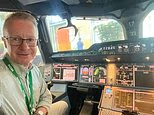
Travel writer Tom Chesshyre pictured with Qantas’s ‘Project Sunrise’, the new plane set to connect London and Sydney directly from autumn next year
The Daily Mail had a sneak preview at the Airbus headquarters in Toulouse, France
So, when are these planes beginning?
Qantas says they will start in October 2027 on specially commissioned A350-1000ULR (Ultra Long Range) aircraft that will have taken around a decade of development – and around five years’ delay.
When will tickets go on sale and how much will they cost?
Next February. The airline estimates that fares will be 20 per cent higher than current non-direct services, which start at around £1,256 in economy class (for a return journey in November).
So, expect cheapest return fares from £1,500, if this prediction of fares is correct, though they may well be pricier as current year-round return starting fares are from £1,622, and if 20 per cent is added to that the figure rises to £1,946. Prices include checked baggage.
How does this compare to the cost of other return flights with one-stop between London and Sydney?
It’s quite a step up from return fares offered by Etihad that are available from £1,009 (journey time, 22h 40m) or with Emirates from £1,096 (21h 55m).
Will it always be as quick as 18h 7m when the flights begin next year?
No. That’s the absolute speediest time on the London to Sydney route, which benefits from prevailing winds.
The journey time could be as much as 20h 4m, depending on conditions. On the return route from Sydney to London the flight time range, due to a headwind, is from 19h 25m to 21 hours.
Qantas states that its A350-1000ULR planes will shave ‘up to four hours’ off current flight times.
Chesshyre pictured in the cockpit of the plane that travel between London Heathrow and Sydney as quick as 18h 7m
Qantas’s first-class enclosed suites have two metre beds, separate 22in-wide armchairs, thin ‘wardrobes’ for hanging clothing, and large monitors for watching films
But ‘up to four hours’ isn’t much and they’re quite a bit more than competitors’ fares?
True. The direct flights may not be for everyone, especially those on a budget or those who feel claustrophobic on long flights.
However, Qantas is confident that enough people will want to fly ‘point to point’ avoiding the hassle of getting off halfway.
So how will the planes be configured?
Each ‘Project Sunrise’ plane will take 238 passengers, with planes initially configured with 98 economy-class seats, 42 ‘economy plus’ seats, 40 in premium economy, 52 in business-class and six in first-class.
What’s the difference between economy and ‘economy plus’?
Regular economy seats will range in size between 32in and 33in pitches, while ‘economy plus’ seats will be 33 inches.
How much will premium, business and first-class seats set you back?
Based on Qantas’s current year-round starting fares, premium economy return seats will be from £3,664, business from £7,851 and first-class from £13,922 – these include the 20 per cent mark up for the direct service.
What are the seats like?
Qantas this week revealed its swish first-class enclosed suites, which will have two metre beds, separate 22in-wide armchairs, thin ‘wardrobes’ for hanging clothing, and large monitors for watching films.
The décor is in muted colours featuring shades of grey – sophisticated, not blingy.
The planes have been fitted with extra fuel tanks able to carry 20,000 litres more fuel allowing them to travel so far without stops
How about economy seats?
They are fairly standard, coloured red – and it is luck of the draw whether you get a 32in or 33in seat; 30 per cent of economy seats will be 32in.
Premium economy seats are a substantial step up, coloured grey, with 40in seat pitches and adjustable winged ‘privacy’ headrests.
Will there be any place to relax beyond your seat?
Yes. Following consultation with experts at Sydney University, Qantas has set aside space for a nifty ‘Wellness Zone’ located between the premium economy and economy cabins, with handles attached to walls that allow passengers to stretch and space for yoga.
There will also be a hydration station and a range of ‘premium refreshments’ – and it’s said to be a world first on a commercial flight.
Where does the name ‘Project Sunrise’ come from?
Between 1943 and 1945, Qantas flew extraordinary continuous propeller plane flights between Perth in Western Australia and Sri Lanka using Catalina flying boats that lasted 30-plus hours and took in two sunrises.
The name is a nod to those heroic journeys, and lighting on board the new plane has been specially designed so that there are nine-minute slow, subtle changes to create a ‘sunrise’ effect.
How are these planes able to go so far?
Because they have been fitted with extra fuel tanks able to carry 20,000 litres more fuel.
This will allow the planes to travel 11,500 miles – and the distance between Sydney and London is around 10,500 miles, although routes vary in length. This will make it the longest continuous commercial flight on the market.
The new planes are also planned to go between Sydney and New York, probably in early 2028
What was the previous longest continuous flight?
This was between Singapore and New York JFK offered by Singapore Airlines, a distance of 9,537 miles – so the new flights are more than 1,000 miles further and an extra two hours.
There are already direct flights from London to Perth in Western Australia, which began in 2018 – 9,009 miles.
Will Qantas’s new planes fly anywhere else?
They are already planned to go between Sydney and New York, probably in early 2028, and there will be services to South America and South Africa.
Other airlines have put in orders including Singapore Airlines, Lufthansa and Air India, but no planes will be delivered to them before 2030. Qantas’s initial order is a dozen planes.
Source link
CHECK OUT: Top Travel Destinations
READ MORE: Travel News