

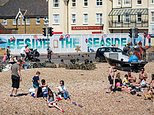
When it comes to revealing your upcoming UK staycation spot to friends and family, the response you get might differ greatly depending on who you’re talking to.
Some British beachside resorts will be met with a starry-eyed ‘oooh’ from elderly relatives – while at the same time eliciting a raised eyebrow and judgmental grimace from anyone below the age of 40.
That’s because many of the great British seaside towns of old have had an unfortunate ‘glow-down’: instead of the previously enviable sandy shores and coastal hotels that once lured in tourists each summer, a large number are left with both their streets and reputation in tatters.
From Lancashire locations to the Essex enclaves known nowadays for their beaches covered in discarded crisp packets and gaudy piers, plenty of formerly swish seaside towns have lost their allure.
Here, the Daily Mail takes a look at the worst of the lot – does YOUR next beach destination feature? If so, you might want to consider if you’re shore it’s the best idea…
Blackpool, Lancashire
Views of Blackpool Tower usually demonstrate the vast coastline – not the run-down housing hidden just behind the tourist landmark
The Blackpool Tower, pier and coastline have provided the backdrop for many a British family holiday over the last few decades – but in recent years, the town has gone from dynamic destination to hopelessly gauche.
Indeed, when a town markets itself as ‘affordable’, all too often that goes along with another description – ‘tacky’.
Blackpool was at its best from the 1870s to the 1950s, when new railway links made it easily accessible, a win for those living in landlocked towns across the UK.
In the 1980s, it had a reputation for a vibrant nightlife – but unfortunately competition from increasingly easy-to-book Mediterranean holidays became far more appealing than, well, a weekend by the Irish Sea.
Healthy life expectancy in Blackpool sits at around 54.5 years, roughly the same as that of African country Angola – where an estimated three in five live in extreme poverty.
That means not only has the town lost its glossy veneer – it has some pretty deep-rooted issues beneath the surface, too.
Great Yarmouth, Norfolk
Great Yarmouth in Norfolk is one of the most deprived parts of the UK
Much like Blackpool, the invention of the railways in the 19th century saw an influx of visitors to Great Yarmouth – but nowadays, its struggle is with deprivation and decline.
The 32nd most income-deprived local authority in England, Great Yarmouth is also rife with housing pressures, high unemployment, below-average salaries and poor education.
It’s undergoing long-term development, with local councillors aiming to revamp the town for the future.
But much of that work remains to be seen.
Bognor Regis, West Sussex
Beachgoers relax on the beach in Bognor Regis – but it’s a far cry from a sunshine-filled paradise
Ah, Bognor Regis, synonymous with the great Butlin’s weekender and screaming children running amok.
If you’re after a nostalgic and perhaps chaotic fish and chips on the beach, this is the place for you – but if you’re seeking a sleepy seaside haven, perhaps it’s better to turn your attention elsewhere.
Bognor Regis was named by consumer group Which? as the joint-worst seaside resort in Britain last year, and receives many critical reviews.
One beach in the region is even considered unfit for swimming; the bathing water at Aldwick beach has been classified as poor since 2022.
The Environment Agency has said: ‘The surface water drainage is suspected of being a significant source of contamination to the bathing water. The investigations have involved sampling the numerous surface water outfalls to the beach during wet weather events.’
Morecambe, Lancashire
Morecambe’s coastline has been on the decline as of late
Until recently, former world heavyweight champion Tyson Fury called Morecambe home – and despite his frequent protestations of the town’s beauty, anyone watching the Netflix series At Home With The Furys will have seen otherwise.
Grotty beaches, run-down beachfront restaurants and a generally grey ambience characterise the Lancashire destination.
The now-dubbed ‘Costa Geriatrica’ was thriving until the 1970s – and was frequently the butt of seaside jokes, known as the beach ‘where seagulls don’t land anymore’.
Deeply unfashionable and now more of a retirement destination than holiday resort, Morecambe is to be avoided.
Rhyl, Denbighshire
Rhyl in Denbighshire has all the hallmarks of a run-down seaside spot
If seven identical stores selling an assortment of neon pink beach balls, crocodile lilos and £2 buckets-and-spades float your boat, by all means pay a visit to Rhyl.
But if you’re after a gorgeous beach holiday, you might want to turn your attention elsewhere.
In the 1900s, you would have seen horse-drawn carriages in the main centre – nowadays, the high street is more likely to contain old cars, empty storefronts and a generally dismal atmosphere.
The exodus of tourists in favour of foreign holidays, and the subsequent closure of many shops in the region, from M&S to GAME, has contributed to its stark decline.
The area around Rhyl high street is officially the most deprived neighbourhood in Wales, according to the Welsh Index of Multiple Deprivation (WIMD) – and that says it all.
Bangor, Gwynedd
Glossy beachfronts and a holiday ambience are hard to find in Bangor
The title of ‘worst seaside destination in the UK’ is certainly impressive given the fierce competition.
But Bangor, which received one-star ratings for food and drink, tourist attractions, and shopping in a Which? study, very much deserves its crown.
Bangor has racked up the most debate, with many arguing it’s not nearly as bad as nearby areas – with plenty saying fellow Wales spot Rhyl is far worse.
With shops closing and derelict buildings a more common sight than sun loungers and beachside cocktails, it’s no surprise the graffiti-filled city takes the top spot.
Clacton-on-Sea, Essex
Clacton-on-Sea in Essex was once a favourite – now? Not so much…
Clacton-on-Sea was named one of the UK’s worst seaside towns in a Which? survey – and Clacton (Groyne 41) beach, located near the pier, has even been called Essex’s worst beach by EssexLive.
Swimming is not currently advised here due to poor water quality, a real downer for any seaside holiday. If you can’t take a dip in the water then, quite frankly, what is the point?
Unemployment is rife here, and a lack of education has greatly contributed to the town’s decline.
It in no way resembles its Victorian heyday, when its iconic pier was more ‘happening jaunt’ than ‘tired and full of screaming children’.
Skegness, Lincolnshire
Hotels and attractions in Skegness have been on the decline
Safe to say, Spanish tourists visiting the UK for the first time would be horrified if Skegness was their first foray into the British seaside.
Most turn their nose up at Skegness – and with the traditional town no longer a beachy haven for British families, there’s no need to ask why.
Sunburnt shoulders, screaming toddlers and flashing neon lights replace the nostalgic feel of this beachside staycation.
Not to mention it’s been home to the original Butlin’s resort on the Lincolnshire coast since 1936.
‘Loser’s paradise,’ the ‘worst beach ever’, and ‘discarded underwear’ strewn everywhere are just some of the criticisms piled on this seaside town.
Steer clear at all costs.
Source link
CHECK OUT: Top Travel Destinations
READ MORE: Travel News