

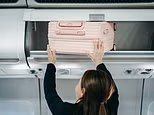
Budget flights often look like a bargain – until you reach the baggage section and discover the extra fees mounting up.
Soon, however, travellers will be able to see the true cost of their flight upfront, rather than discovering baggage fees later in the booking process.
Airlines are set to be banned from offering extremely low flight prices before then charging passengers extra fees to bring cabin baggage on board.
Under new European rules announced earlier this month, air fares including hand luggage will need to be displayed by default before the start of any booking process to allow fare comparisons between airlines.
So, what do we know so far – and how will you be affected?
What are the new rules?
According to new EU baggage rules, airlines will need to show the costs up front
Airlines will need to show fares with hand baggage included from the outset.
Passengers will be allowed to bring a free personal item with a maximum size of 40cm x 30cm x 15cm.
While airlines that include luggage in ticket prices, such as British Airways, will be unaffected, low-cost companies such as Ryanair and easyJet will see changes.
The European Parliament announced earlier in July: ‘The new rules now include the right to carry on board, without additional fee, one personal item, such as a small bag or backpack.
‘On the insistence of MEPs, price transparency and the comparability of air tickets was increased by obliging airlines, intermediaries and search portals to always display the air fare inclusive of carry-on luggage at the outset of the booking process.’
How is this different from before?
Anton Radchenko, aviation expert and founder of AirAdvisor, told the Daily Mail: ‘It’s worth clearing up a common misunderstanding first, because the new rules are often being described as cabin baggage charges being removed or scrapped, and that isn’t quite what is happening.
‘From the point the rules take effect, expected in the second half of 2027, every passenger on a flight covered by the regulation will have the right to bring one personal item on board, such as a handbag, laptop bag or small backpack, at no additional charge.
‘On top of that, airlines, booking sites and comparison engines will have to show fares that include a hand baggage allowance from the very start of the booking process, so passengers can compare the true cost of a trip across different airlines.’
But how is this different from before?
From 2027, passengers will have the right to take a bag on every flight
Anton explains: ‘Today, the personal item and the cabin bag are often unbundled from the headline fare. You see a low advertised price, and then the cost of bringing a bag is added later in the booking flow, or at the gate if you get it wrong.
‘That has made it genuinely difficult for passengers to compare one airline against another, because the advertised fares do not measure the same thing.
‘The change here is twofold: the free personal item becomes a guaranteed right rather than something that varies by airline, and the price you first see has to reflect the cost of carrying hand luggage.’
Do the rules apply to UK airlines?
While the rules apply to the EU, in practice it is likely the UK will be affected.
Consumer champion Which? said while the UK is not obliged to follow the rules, ‘the reality is that they will have to’.
It added: ‘These rules apply to EU airlines, such as Ryanair, but also to airlines flying from the EU to the UK, including UK carriers such as easyJet.
‘It would be impractical for UK carriers to apply one set of bag rules and charges on inbound flights from the EU, and outbound legs from the EU.
‘It’s likely that UK carriers will implement the same rules on flights to the EU.’
When do the rules begin?
The rules are expected to come into force in 2027.
The exact date has not yet been announced.
How will this affect flight prices?
If you’re travelling with a family, you might have several bags – if you opt out, you could save cash
A recent Which? investigation looked at the prices of 1,500 cabin bags across Ryanair, Wizz Air and easyJet and found the lowest advertised price was almost never available.
So while the news may be welcomed by passengers, airlines have warned it could lead to a hike in air fares.
Budget carriers, which currently charge extra for luggage, may see a price increase in their tickets.
Could any savings be made?
There have been concerns flight prices will appear elevated as a result of up-front fees being shown.
However, travellers who choose to fly without baggage will be able to opt out at a later stage in order to pay a lower fare.
Based on current prices, if you’re travelling with easyJet, for instance, you could pay up to £60 for an added large cabin bag.
For a family of four travelling, this could total a whopping £240 – making this a potential saving if you opt out.
How have major airlines responded?
Earlier this year, before they were confirmed, easyJet called the proposals a ‘lunatic idea’.
A statement from Airlines for Europe, Europe’s largest airline association, said the ‘deal is a missed opportunity for a balanced reform that would have delivered what passengers care about most: getting to their destination on time and having the freedom to opt for the services that matter to them.
‘Maintaining the current delay and compensation rules will not reduce or prevent delays and cancellations, most of which are outside airline control.
‘Obliging airlines to artificially inflate prices by including the cost of hand baggage in the displayed airfare contradicts established EU law protecting opt-ins instead of opt-outs.’
Source link
CHECK OUT: Top Travel Destinations
READ MORE: Travel News