
Many holidaymakers are accustomed to paying an overnight levy when visiting a popular destination.
Tourism tax has been introduced in many hotspots around the world to help manage the high numbers of visitors and bring extra revenue into the area.
The amount can vary, from a few euros a night extra in Rome to a percentage of the room rate in Amsterdam.
Closer to home, Manchester introduced a City Visitor Charge back in 2023, and Edinburgh is set to bring something similar in from July.
The UK government is now proposing to give city mayors and town officials across the country the authority to charge a small fee for overnight stays.
Here are all the destinations around the world that might require you to pay an extra fee for staying there…
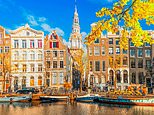
Holidaymakers in Amsterdam are expected to pay 12.5 per cent extra on top of the cost of their hotel room
Amsterdam
Tourists heading to check out the vibrant nightlife, colourful architecture and culture of Amsterdam are expected to pay 12.5 per cent extra on top of the cost of their hotel room.
Called ‘Toeristenbelasting’, it’s one of the highest visitor fees in Europe, and was increased from seven per cent, plus €3 (£2.60) per person, in 2024.
It applies to hotels, B&Bs, campsites and holiday lets.
Meanwhile, cruiser-goers have to pay a different day-tripper tax of €14.50 (£12.50) per person.
Bali
The popular Indonesian island has charged international tourists IDR 150,000 (£6.80) since February 2024.
The fee applies per person, rather than per person per night, and can be paid on or before arrival at the airport.
Travellers aged over 16 are expected to pay a varying local rate plus 10 per cent VAT when visiting spots including Mallorca, Menorca, Formentera and Ibiza.
The rates decrease during off-season months, typically between November and April.
Barcelona
From April 1, tourists visiting Barcelona could face nightly fees of up to €15 (£13) following a significant increase in the local tourist tax
From April 1, tourists visiting Barcelona could face nightly fees of up to €15 (£13) following a significant increase in the local tourist tax.
Under new regulations, set to come into force in April, the regional parliament of Catalonia has doubled the tax for holiday rental guests to a maximum of €12.50 (£10.90) per night, up from €6.25 (£5.45).
The rise comes ahead of a previously announced plan to ban all short‑term rental accommodation by 2028.
Hotel guests will soon be required to pay between €10 (£8.75) and €15 (£13) per night, up from €5 (£4.35) and €7.50 (£6.55), depending on the category, with the likelihood that guests will pay more at four and five-star hotels.
The new fees mean a two-night stay for a couple booked into a four-star hotel – which make up nearly half of all hotels in the city – could cost an extra €46.60 (£40), as solo guests can be charged up to €11.40 (£9.95) per night.
Meanwhile, guests staying at five-star hotels could face fees of up to €15 (£13), while cruise passengers will continue to pay approximately €6 (£5.20).
Berlin
Holidaymakers visiting the capital of Germany have to pay a City Tax of 7.5 per cent each night.
The charge was originally introduced to private overnight stays in January 2014 but was extended to business trips from April 2024.
Bhutan
In Bjutan, travellers from everywhere except India pay a whopping $100 (£75) per person, per night. Visitors from India are charged INR 1,200 (£9.55) per person, per night.
Bhutan might offer impressive mountains and landscapes to explore, but the incredible experiences come with the most expensive tourist tax in the world.
Travellers from everywhere except India pay a whopping $100 (£75) per person, per night. Visitors from India are charged INR 1,200 (£9.55) per person, per night.
Those aged between six and 12 years old have a 50 per cent discount and visitors under five years old are exempt.
France
Municipalities across France can charge a taxe de séjour, which can be applied, as well as an additional city tax.
The charge, used in popular cities, varies between 65 cents to €15.60 (55p to £13.50) per person, per night, in Paris, depending on the quality of the accommodation.
Greece
The Greek government introduced a Climate Resilience Tax for anyone visiting Greece.
The charge is calculated per room, per night and visitors are asked to pay when they check into their accommodation.
Between April and October, travellers are charged between €2 (£1.75) and €15 (£13) per room, per night depending on the star rating of the hotel.
This is reduced to between 50 cents to €4 (43p to £3.45) to between November and March.
The Greek government introduced a Climate Resilience Tax for anyone visiting Greece
Japan
From March this year, tourists have been asked to pay between 200 yen (94p) to the maximum cap of 10,000 yen (£47), across five tiers to visit per night in Kyoto.
Ljubljana
From January 2019, tourists have been charged €3.13 (£2.71) per day, and those between seven and 18 years old €1.57 (£1.36) to visit the capital of Slovenia.
This includes a €2.50 (£2.16) tourist tax as well as a 63 cent promotion tax.
New Zealand
New Zealand charges an International Visitor Levy of $100 (£43.35) when tourists apply for a visa or electronic travel authority.
Portugal
Some 43 municipalities in Portugal expect visitors to pay a fee, which varies on the location.
Tourists are charged from €4 (£3.46) per person, per night to €28 (£24.22) during their visits to Lisbon.
Those heading to the Algarve, including regions like Albufeira and Faro, are often charged between €1 to €2 (86p to £1.73).
Meanwhile in Porto, tourists are charged €3 (£2.59) per person, per night and this is capped at a maximum of €21 (£18.16).
Tourists are charged from €4 per person, per night to €28 during their visits to Lisbon
Prague
The Prague government set a tourist tax for visitors aged over 18 years old 50 Czech Koruna (£1.77), per person, per night.
It was previously only 21 Czech Koruna (74p) – making it one of the cheapest tourist charges in the world – but was increased in 2022.
Switzerland
A tourist fee in Switzerland varies by the region between 2.5 Swiss Franc (£2.36) and 4.75 Swiss Franc (£4.49) per night.
In Basel, the charge is four Swiss Franc (£3.78), in Geneva 4.75 Swiss Franc and Zurich 2.5 Swiss Franc.
Italy
Visitors to Rome have to cough up between €3 (£2.60) and €10 (£8.65) per person, per night, depending on the accommodation.
Meanwhile in Venice, there is an entry fee for tourists of €5 (£4.33).
Vienna
The capital of Austria charges 3.2 per cent of the cost of the accommodation per night.
UK cities
Visitors to Manchester have paid a City Visitor Charge since 2023, and plenty of other spots around the world apply a similar fee
A tourism tax is already in place in several UK cities, and Manchester was the first to do so in 2023.
Others are set to introduce charges later this year, and the government are proposing for city mayors and town officials to be given the authority to charge a small fee for overnight stays.
It would apply to visitors staying at hotels, holiday lets, Bed and Breakfasts, and guesthouses.
Manchester
Travellers visiting the ‘capital of the North’ will see an additional £1 fee on accommodation bookings – called the City Visitor Charge.
Liverpool
Holidaymakers heading to Liverpool also have to pay a £2 City Visitor Charge.
Aberdeen
A seven per cent charge is set to come into play from April 2027 at the earliest in Aberdeen.
Edinburgh
Holidaymakers exploring Edinburgh’s historic streets will be charged five per cent of the cost of their overall visit from July 24.
Glasgow
The Visitor Levey Scheme, allowing Glasgow to charge tourists seven per cent on their stay, will be introduced in January 2027.
London
Mayor of London Sir Sadiq Khan received powers last year to levy a tax on overnight visitors, which he said would ‘directly support the capital’s economy and help cement our reputation as a global tourism and business destination’.
Through changes enabled by the Autumn Budget 2025, city mayors and town officials will have the authority to charge a small fee for overnight stays in accommodations such as hotels, B&Bs, guesthouses and holiday lets.
In November, Lambeth Council called for a tourist tax to be introduced in the borough and across London.
Lambeth Labour pushed for an ‘Overnight Visitor Levy’ that they argue would be a ‘fair and progressive’ way to practice sustainable tourism for the local community.
‘An overnight levy, sometimes called a tourist levy, would be a small charge paid by tourists and visitors on accommodation costs such as hotels and short-term lets,’ the council penned on an online petition.
Source link
CHECK OUT: Top Travel Destinations
READ MORE: Travel News