

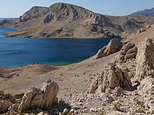
Croatia is renowned for its lush green landscapes, charming medieval towns and sparkling blue waters, but one island tells a different story.
On the northern side of Pag, the land turns pale, rocky and almost otherworldly – a wind-shaped world that looks more like the moon than the Mediterranean.
Locals have long dubbed it ‘Moon Island’ and it’s easy to see why.
The terrain is largely made up of limestone, rolling ridges and sparse fields that stretch for miles, and with few trees and little shade across the island, there’s barely any colour to break up the extraordinary view.
According to Toni Hrelja, founder of Croatian rental company Villsy, spring is the best time to experience the island’s extraterrestrial vibe.
He said: ‘People expect Croatia to be green and Mediterranean. Then they arrive on Pag and feel like they’ve landed on the Moon, or even Mars. It’s raw, dramatic and completely unexpected.’
In summer, temperatures can reach 30 degrees, and with almost no shade along the northern coast, exploring can be tough.
However, spring offers milder conditions that are perfect for walking and taking in the scenery, with temperatures ranging from around 13 degrees in March and 20 degrees in May.
Pag, an island in Croatia, has earned the nickname ‘Moon Island’ thanks to its stark, wind-swept landscape
Pag’s terrain is largely made up of chalky limestone, rolling ridges and sparse fields that stretch for miles – with few trees and vegetation
On the other side of the island, a colourful marina offers a striking contrast to the the raw terrain found on the northern coast
British travellers can also reach the island easily thanks to its close proximity to the UK.
The best way to reach Pag is by flying into Zagreb, with one-way Ryanair flights starting from an ultra-low £15 in mid-April.
From Zagreb Airport, it’s worth hiring a car and driving three and a half hours south to the island, as it offers ample opportunity to catch some spectacular views of the dramatic mountain landscape along the way.
One of the most striking areas is around Metajna on the northern coast, where Paj earns its lunar nickname.
Fierce Bura winds from the Velebit mountains have shaped the land over centuries, carrying salt that stripped away vegetation and left behind bare, pale rock.
In bright sunshine, the ground turns almost white, giving the area its unique ‘moon’ look.
Nearby, Beritnica beach is just as unusual, with smooth stone instead of sand, and three large boulders sitting in the shallow water.
Above it is Stogaj – a sharp, sculpted rock formation that adds to the striking setting.
Visitors are warned to plan visits wisely during the summer, as the island provides little shade from 30C sun
A particular striking area is Metajna, which earns Paj its lunar nickname
The chalky, colourless landscape provides a dramatic contrast to the surrounding blue sea
Higher up, the plateau around Sveti Vid – the island’s highest point – is wide, empty and treeless, with rolling views across a landscape of pale karst rock, cracked limestone and open sky.
Strong sunlight turns the limestone turns chalky and colourless, creating a vast, open landscape that mirrors the surface found on the moon.
Then there’s the Pag Triangle – a mysterious geometric shape set into the rock near Novalja.
Surrounded by bare stone and wind-swept ridges, the setting only adds to the island’s otherworldly feel.
Meanwhile, an expert has shared three of Croatia’s must-visit hidden gems to avoid tourists this summer.
According to Joanne Lynn, a travel expert at Riviera Travel, these are three lesser-known locations hidden amidst the more commonly frequented hotspots, waiting to be unearthed and explored.
Joanne said: ‘A trip to Europe provides many opportunities to immerse in fascinating history, explore stunning landscapes, and learn about different cultures. Croatia has plenty of these features and has some incredible hidden gems.
‘Whether you’re seeking an enriching, history-rich trip or a refreshing getaway to a coastal haven, Croatia is home to many must-visit spots in 2025.’
Often described as Croatia’s greenest island, Mljet is an almost otherworldly location brimming with dense pine forests and a stunning national park.
Regarded as Croatia’s ‘best-kept secret,’ Vis was once closed to tourists for decades, having formerly served as a Yugoslav military base.
Today, it’s the farthest inhabited island off the Croatian mainland, perfect for visitors seeking an authentic, unspoiled escape.
Unlike many Croatian islands known for their rocky shores, Rab boasts some of the best sandy beaches in the country.
A haven for beach lovers, Paradise Beach, based in Lopar, is celebrated for its shallow, warm waters and family-friendly atmosphere.
Source link
CHECK OUT: Top Travel Destinations
READ MORE: Travel News