
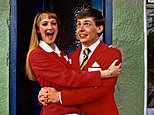
A pioneer of the British seaside break, Butlin’s has evolved considerably since opening its first resort in 1936, although much of its original charm – centred around its famous Redcoat entertainers – still remains.
At its peak, the brand ran ten holiday camps spanning England, France and even the Bahamas, before a combination of challenges – including the rise of cheap package holidays abroad – led to most closing throughout the 1980s and 1990s.
Today, just three of those original resorts – Skegness, Minehead and Bognor Regis – remain in operation…but they’re hugely popular.
Butlin’s continues to draw in both families seeking affordable bucket-and-spade holidays as well as grown-up weekenders with its adult-only breaks.
This month, the brand marks its 90th anniversary – and is set to celebrate in style.
Party like a redcoat! One of Britain’s most famous holiday brands celebrates its 90th birthday this month…
Legs 11! Bathers pose up a storm at Skegness in the 1930s, the brand’s first holiday camp, which is one of the three Butlin’s sites currently in the UK
Kicking off this weekend, each of the resorts is hosting three nights of special shows and activities, led by the Redcoats and resident bears Billy and Bonnie.
To mark the exact moment Billy Butlin cut the ribbon to officially open the Skegness site on April 11, 1936, a nine-minute firework and laser display will take place simultaneously across the trio of British resorts at 7.36pm.
Guests can enjoy birthday party bingo, complete with themed games, dance moments and a special highlight when the number 90 is called.
The brand’s story is filled with nostalgia for many Brits – with grandparents and parents now introducing the latest generation to the holiday park fun.
How have things changed for those checking in through the decades? Let’s take a closer look…
1930s: Cutting the ribbon on Skegness
Pictured: Billy Butlin (far left) with pilot Amy Johnson (centre) at the opening of the very first Butlin’s site in Skegness in 1936
Diving into a British favourite: The holiday camp came about after William ‘Billy’ Butlin bought a plot of land in the Lincolnshire seaside town, where the resort is to this day
In 1936, William ‘Billy’ Butlin – joined on opening day by Amy Johnson, the first woman to fly solo from England to Australia – unveiled his first holiday camp in Skegness on the Lincolnshire coast.
It started on a short visit to Barry Island where Billy felt sorry for families staying in drab guest houses with nothing much to do.
The entrepreneur wanted to create a ‘place of colour and happiness’ where quality activities and entertainment would be provided so that families could really enjoy their time together.
Collab: The increasingly popular park teamed up with the London and North Eastern Railway (LNER) to promote the park
Holidaymakers on a fairground ride at Butlin’s in Skegness in 1936
Japes – happy campers playing team games in Skegness in 1939
So, in 1936, Billy bought a plot of land in Skegness (where the resort is to this day) and set about making this dream come true.
Branding itself as a ‘Luxury Holiday Camp’, the resort offered an affordable, all-inclusive style break with scheduled entertainment – something largely unheard of at the time.
It quickly proved popular with working and middle-class families, with guests enjoying live variety shows, singalongs, talent contests and games led by the original Redcoats, who would quickly become central to the Butlin’s experience.
After a hugely successful opening, the brand wasted no time in expanding, with a second site in Clacton opening in 1938 and a third in Filey undergoing construction the following year.
Plans for further growth were halted by the Second World War, which was declared in 1939.
1940s: Soldiers not tourists
During WWII, Skegness and Clacton were taken over by the Government and repurposed for military use, with the latter becoming an army camp and the former transformed into HMS Royal Arthur.
Entertainment was replaced by drills and training, though the sites’ large communal spaces proved ideal for hosting troops.
During the war, the half-complete Filey holiday camp was handed over to the government for military use, after which Billy Butlin secured a deal to repurchase the site for 60 per cent of its original construction cost.
Holidaymakers play and splash around in the water in an outdoor pool at the holiday camp in Clacton-on-Sea, Essex, in 1948 – but the park was also given over for military use during the Second World War
When the war finally ended, British families flocked back to Butlin’s resorts for ballroom dancing (pictured), variety shows and more
The resort, which became known as RAF Hunmanby Moor, partially opened in June 1945 before evolving into the so-called ‘king’ of holiday camps with 400 acres of space and capacity for over 11,000 guests.
Butlin’s expanded rapidly mid-decade, with Billy Butlin awarded an MBE in 1944.
Skegness, Clacton, and Filey reopened, while new resorts launched in Ayr, Pwllheli, and Mosney.
With foreign travel limited, visitors flocked to enjoy live theatre shows, ballroom dancing, variety acts, fairground rides and communal activities – a welcome escape after years of hardship and isolation.
Hotels in Saltdean, Brighton, and Blackpool were added, and later in the decade, Butlin planned a 1,000-guest site in Nassau, The Bahamas.
It officially opened in 1950, though it struggled to replicate the success of UK camps and was later sold.
1950s: Butlin’s boom time
The 1950s marked Butlin’s golden age, with up to 50,000 weekly visitors across its camps.
Parks were upgraded with new facilities and enhanced entertainment to improve visitor experience.
During this era, a full week’s stay cost up to £10, including three meals a day and activities.
Indoor heated pools debuted at Ayr, Clacton, Pwllheli, and Skegness for use ‘whatever the weather’.
A pyramid of bikini-clad tourists posing in a water fountain in Clacton, Essex as they take their holiday during the early warm spell at Butlin’s holiday camp
New attractions included amusement parks at Ayr and Skegness, theatres like the Empire Theatre, and miniature railways at Filey and Pwllheli with steam locomotives.
Clubs, contests, and acts expanded, including the Beaver Club and early beauty competitions like Miss She and Glamorous Grandmother. Filey added an indoor pool and even welcomed Charlie the elephant.
At the same time, Butlin’s acquired multiple hotels, including properties in Cliftonville and the Ocean Hotel in Saltdean.
Pictured: The Regency Ballroom at Butlin’s Bognor Regis
In 1959, indoor heated pools were installed at Ayr, Clacton, Pwllheli, and Skegness (pictured) sites for use ‘whatever the weather’
Pictured: Guests look through the glass windows of the Indoor Heated Swimming Pool in Skegness
1960s: The Queen checks in
Pictured: Queen Elizabeth II meeting with Billy Butlin in 1963 when she visited the Pwllheli site with her husband Prince Philip
Skegness Fairground in 1962; the vintage style fairground attractions remain today – and are still a hit with tourists
In the 1960s, Butlin’s truly defined the British seaside holiday experience before overseas travel became common.
New resorts opened in Bognor Regis (1960), Minehead (1962), and Barry Island (1966).
By 1963, one million holidaymakers visited camps and hotels – a record year for the brand at the time.
Pwllheli – famously visited by Queen Elizabeth II and Prince Philip in August 1963 – saw its busiest season ever, reaching full capacity for weeks in 1965.
Innovations included monorails, chairlifts, larger theatres, and swimming complexes.
Pictured: Billy Butlin with a family staying at the Pwllheli resort in the 1960s
The Gaiety Theatre in Skegness
Big-name acts, comedy, and contests grew alongside Redcoat activities, with Ringo Starr appearing early in his career.
Another site was acquired and permission given for a further camp at Holme Dunes in Norfolk, but plans were scrapped after the North Sea floods of January 1963.
Billy Butlin retired in 1968, succeeded by his son Bobby, before the business was sold to Rank Organisation in 1972.
Camps peaked at 10, but the problems within the British tourism industry begin to emerge.
1970s: Trickier waters
In the 1970s, visitor numbers declined as cheap Mediterranean package holidays in the likes of Spain and Portugal grew in popularity.
Although chalets underwent major refurbishment, the decade brought a range of setbacks: steam locomotives were removed from several camps, the Playhouse Theatre at Minehead burned down, and Radio Butlin was scrapped.
Amid these challenges, the Butlin family sold the business to the Rank Organisation.
Cheap package holidays to Spain took a chunk of Butlin’s business as holiday trends changed in the 1970s
Pictured: A funfair at Butlin’s Bognor Regis in the 1970s
1980s: Farewell to Billy
The decade began with the sad death of Billy Butlin at 80, his funeral lined by Redcoats. His son Bobby retired a few short years later.
Despite a record 1.2 million visitors in 1980 and major investments in Ayr and Minehead, closures followed: Clacton and Filey shut in 1983, and Barry was sold in 1986.
Deckchair happy: A couple recline in the sunshine in Skegness, affectionately known as ‘Skegg’
A holidaymaker jumps into a swimming pool at the Bultin’s seaside resort in Skegness in 1982 in images shared by award-winning photographer Barry Lewis
With a little bit of this and a little bit of that…British adults born in the 80s will have invariably visited Butlin’s in their childhood
The ‘Hi-de-Hi’ catchphrase was officially banned by the company during this time in an effort to move away from the dated holiday camp perception.
However, new developments continued, including Water Worlds in 1986 and redesigned Redcoat uniforms by Zandra Rhodes in 1989.
Resorts were upgraded – Ayr was renamed ‘Wonderwest World’ and Minehead became ‘Somerset World’ – with new accommodation, indoor pools, food plazas, and facilities, while branding and entertainment evolved.
1990s-2000s: A new era
In the 1990s, Ayr and Pwllheli were transferred to Haven and reopened as caravan parks, while all hotels dating from the 1950s to the 1990s were sold in 1998.
Several camps, including Mosney and Barry Island, closed or were sold.
TV presenter Stephen Mulhern began his entertainment career by joining Butlin’s as a Redcoat at the Minehead resort between 1995 and 1996, later rejoining as a magic show host for three years in a reported £1million deal.
Skegness (pictured), Bognor Regis, and Minehead were rebranded in 1999, receiving a total of £27 million in investment for upgraded accommodation and facilities
However, things began looking up in the 2000s, when Butlin’s was acquired by Bourne Leisure.
Remaining resorts – Skegness, Bognor Regis, and Minehead – were rebranded in 1999 with a total £27million investment and Skyline Pavilions added.
The new millennium brought a range of new additions, with the beloved Billy Bear making character making his debut in 2003.
Spa facilities opened in Skegness, and Butlin’s first on-resort hotel, the £10million Shoreline Hotel was unveiled in 2005 at Bognor Regis, boasting 160 rooms with floor-to-ceiling windows and an Art Deco theme, and leatherette chairs, TVs and en-suites.
A second site, the Ocean Hotel, opened at Bognos in 2009, offering more modern, upscale accommodation.
2010s: Bognor shines
Investment continued with Bognor’s third hotel The Wave Hotel in 2012, the sleek new West Lakes chalet village in Minehead, chalets, and swimming complexes across resorts.
A vast, Art Deco-inspired swimming pool at Bognor Regis in 2019, featuring large-scale slides and capacity for nearly 1,000 guests.
In 2020, all three resorts temporarily closed due to COVID-19, reopening in July 2021 with safety measures like pre-booking and app based services.
To ensure guests could continue to enjoy shows in a Covid-safe way, new entertainment venues like Studio 36 were built, allowing larger audiences in all weather.
The company reported a significant pre-tax loss of over £74million for the 2022/2023 period as it recovered from the pandemic’s impact.
2020s: Watch out Center Parcs
Today, Butlin’s is more popular than ever, with occupancy rates up 15 per cent compared to 2018.
A mega £150million investment has gone into modernising its three UK resorts, with family entertainment now including major branded shows like The Masked Singer Live, Diversity, and Peppa Pig.
Focusing on ‘next-level newness’, the company has unveiled brand new adventure grounds, like the 50,000 square foot PLAYXPERIENCE activity centre at Bognor Regis, and the colossal SKYPARK playgrounds at Skegness and Minehead.
Pictured: The all-new colossal SKYPARK playground in 2023
The 2020s has brought plenty of modern, fun amenities for young guests, including Skyline Soft Play (pictured)
A three-night stay for four people in a two-bedroom Silver Room (above) at Butlin’s Skegness costs £104 per person
Adults-only Big Weekenders have expanded with a variety of themed events Don’t Tell Mama, Absolute 80s, and Back to the 2000s, where activities include bottomless brunches, pool parties, silent discos and fancy dress.
In 2022, the founding Harris family regained control of the company in a £300million deal with a focus on long-term quality and guest experience.
Thanks to the post-pandemic ‘staycation’ effect, combined with rising costs of overseas trips, Butlin’s has become an attractive, high-value alternative for UK holidaymakers – and it’s set for a bumper Easter, with 2026 bookings up 68 per cent.
Source link
CHECK OUT: Top Travel Destinations
READ MORE: Travel News