

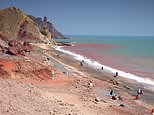
Picture this: beaches of red sand, striking salt caves waiting to be explored, and a dramatic golden valley, all on one island.
The description hints at a truly extraordinary holiday destination – something almost otherworldly. Somewhere to brag about once you’ve returned home.
Where is this fantastic–sounding place? That might be where your travel plans fall flat.
The 16–square–mile Hormuz Island lies just 8km off Iran’s coast, in its namesake – and strategically critical – Strait of Hormuz.
It’s this unlikely travel hotspot that is now at the heart of escalated tensions.
Even with the current two–week ceasefire agreement and the reopening of the Persian Gulf, travel to the region remains uncertain, with official advisories still in place.
The little–known isle, however, is jaw–droppingly beautiful and has caught the attention of many intrepid travellers over the years – but is still relatively unknown.
Shaped like a teardrop, Hormuz Island has surreal landscapes formed from layers of volcanic rocks, salt and minerals glistening in various colours.
Keen traveller Ben, who goes by @benbookstheworld, visited Hormuz Island and says it is the ‘most diverse and beautiful island I’ve ever been to’ in trips to over 50 countries.
In another video, he gushes how the island ‘has some of the most magical spots I’ve ever seen in this world’ and ‘feels like another planet’.
Ben found the best way to get around Hormuz Island – which can be crossed in around 40 minutes – was using a tuk–tuk or scooter.
Hormuz Island is 16–square–mile in size and located just 8km off the coast of Iran but is not very well known
The lesser–known destination has vibrant soil and sand from its mineral–rich and volcanic landscapes
Ben visited Hormuz Island and says most people get around the island by tuk tuk or rental scooter
Nowhere is Hormuz’s colour more striking than in Rainbow Valley, where bands of green, orange, purple, pink and red cut across the landscape.
The island’s vivid palette has earned it the nickname ‘rainbow island’.
On the west side, visitors can find the Goddess of Salt – a shimmering mountain formed from glistening salt crystals.
The formations are believed by locals to hold healing properties, said to dispel negative energy and promote positivity – giving rise to the nickname ‘Energy Mountain’.
‘It looks like we’re on another planet,’ says Jesper Hedlund, @jesperhedlund1 on Instagram, who adds the landscape is reminiscent of Chile’s Atacama Desert.
Further inland, Saffron Valley adds another burst of colour, with bright yellow and deep golden that resemble fields of saffron in bloom.
The landscape is formed from iron oxide and other minerals, making it a perfect spot for hikers looking for impressive views as well as geologists and nature lovers seeking out impressive formations.
The Rainbow Valley (pictured) is the perfect spot to admire the island’s vibrant hues, loved by travellers and geologists
For visitors looking for an equally colourful place to stay, the island’s hippy–looking Majara Residence is an option
Another shade dominates Hormuz’s palette at the aptly named Red Beach.
Here, vivid crimson sand stretches to the shoreline.
The island is abundant with red soil, called ‘gelack’ by locals, which is considered to be edible and is rich in iron oxide.
It also plays a role in the local cuisine, used as a spice in sauces and jams, according to a local tourist board.
The soil also has value for industrial purposes, used in dyeing, cosmetics, glass and ceramics.
When it rains, the water runs off the ground in bright red streams, which travel content creator Ankita Kumar, @monkey.inc on Instagram, describes as looking like ‘a literal bloodbath’.
The phenomenon, which happens all year round, drew widespread attention last year when footage circulated online showing rainwater turning the beach a striking shade of red.
Floodwater running off the rocks at the tourist attraction created spectacular waterfalls, leaving an eerie trail behind.
Tour guide hormoz_omid shared the video to Instagram to nearly one million likes and stunned reactions.
Artists use the island’s natural colours to create stunning carpets on the sand with natural minerals
It’s caused by the high iron oxide content in the volcanic soil, which mixes with seawater to give the shore its distinctive glow.
Artists often use coast to create expansive sand carpets, transforming the beaches into vast, swirling works of art.
‘To mimic nature, they have also built these sustainable, colourful homes that you can stay at,’ Ankita reveals in a video, referring to the bohemian–style Majara Residence, part of the Presence in Hormuz project.
Consisting of 17 bohemian–style domes made from rammed earth and sand, the colours reflect the island’s vibrant landscape and provide a sustainable – and spectacular – place for visitors to stay.
There are hotels on the island, too, including the Red Beach Hotel and the House of Sun.
Elsewhere, Turtles Cliff has been described as looking similar to Australia’s dreamy shores.
Mostly untouched, it is one of the most important habitats for sea turtles in the country, according to Walking In Iran.
The pristine location becomes home for countless of turtles who head to the area to lay their eggs in the spring and summer.
Hormuz Island remains remote and surreal, as well largely undiscovered. It is as difficult to reach as it is to forget.
Accessible only by ferry from Bandar Abbas or nearby Qeshm Island, it remains – for now, even with a fragile peace deal in place – isolated.
Source link
CHECK OUT: Top Travel Destinations
READ MORE: Travel News