
A newly approved airport in Saudi Arabia is set to provide direct access to Islam’s holiest city, which hosts more than one million foreign pilgrims each year.
A Saudi official confirmed that Mecca will soon have its own international airport and metro system, each designed to improve access for visitors who travel for Hajj, a five to six-day pilgrimage that takes place in the summer, and Umrah, which can be completed at any time of the year.
As Mecca does not currently have a functional airport, many international visitors are forced to travel into the holy city through various entry points.
The preferred route for most is to fly to King Abdulaziz International Airport, located in Jeddah, around 100km from the holy city. The remainder of the journey is completed via car or bus.
Mecca’s mountainous terrain was previously deemed too hazardous for an airport, with the potential for turbulence, limited visibility, and difficult landing conditions
However, in 2024, officials successfully tested self-driving aerial taxis designed for pilgrim transport between holy sites, emergency travel and delivering medical equipment.
In a meeting with Harvard Business Review Arabia last week, Saleh Al-Rasheed, CEO of the Royal Commission for the City of Makkah Al Mukarramah and the Holy Sites (RCMC), confirmed the ‘approval of the strategic and investment directions for the Makkah International Airport’.
The hub, which is set to be developed alongside the private sector, will provide ‘world-class standards’ for both residents and visitors, all while maintaining ‘the economic balance of neighbouring regional airports’.
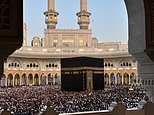
Mecca in Saudi Arabia welcomes over one million foreign pilgrims each year – and travel is set to become easier with newly approved plans for an international airport in the city
Mecca was previously deemed too hazardous for an airport due to its mountainous terrain, with many travellers forced to fly into Jeddah – 100km away – and travel into the city by car or bus (Pictured: Al Hada road to Mecca)
Plans for the ‘Mecca Metro’ were also unveiled – offering a significant upgrade for the 185 million passengers who have relied on the city’s bus system, which comprises of 400 vehicles that cover 580 kilometres across 12 routes.
Al-Rasheed said: ‘The feasibility studies and initial designs have been completed and submitted to the relevant authorities to complete the necessary procedures in preparation for launching it in its next phases.’
Last year, around 1.5 million foreign pilgrims arrived into Mecca for Hajj, according to data released by the General Authority for Statistics (GASTAT).
In 2024, international pilgrims from regions including Europe, America, and Australia accounted for 3.2 per cent of travellers, as reported by Euro News.
Hajj, which takes place during the 12th month of the lunar calendar (Dhu al-Hijja), is one of the Five Pillars of Islam, a lifetime requirement for Muslims who are physically and financially able.
In recent years, the Gulf nation has revved up its offering of new attractions and facilities in a bid to attract more tourists.
But amid the current political landscape, with the ongoing wave of violence erupting across parts of the Middle East, the tourism industry is facing a £35 billion loss – and the megacity plans are at risk.
Brits – and other international visitors – travelling to and within the Middle East are facing severe disruption to their holidays and travels.
In 2025, around 1.5 million international pilgrims travelled to Mecca for Hajj (pictured)
Flights to many major hubs across the region have been cancelled or suspended, with the region in turmoil and the future of its travel industry up in the air.
A recent report by Tourism Economics has revealed the potentially devastating impact of the war on tourism.
Director of global forecasting Helen McDermott and senior economist Jessie Smith said: ‘We estimate inbound arrivals to the Middle East could decline 11-27 per cent year on year in 2026 due to the conflict, compared to our December forecast that projected 13 per cent growth.
‘In absolute terms, this would mean a range of 23-38 million fewer international visitors compared to our baseline/previous forecast, and $34bn-$56bn (£25bn-£42bn) loss in visitor spend. This includes expected lingering sentiment impacts beyond the immediate conflict period.’
Source link
CHECK OUT: Top Travel Destinations
READ MORE: Travel News