
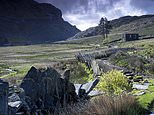
Tucked away in Snowdonia National Park is an abandoned village that hasn’t been inhabited since the 1940s.
Cwmorthin was a slate mining village near Tanygrisiau, Gwynedd and dates back to the 11th Century.
It was once home to a bustling community but now the only humans that walk through the area are curious hikers.
Cwmorthin Quarry is located nearby the village which was active from 1810 and gained the area significant importance over the years by boosting the local economy and providing jobs for the villagers.
The quarry also became connected to the Ffestiniog Railway in 1860, Travel and Tour World reports.
But things changed when the slate industry collapsed after a decline in demand.
With little work in the area, many locals left and Cwmorthin was mostly abandoned by the 1940s.
It has since been left to turn to ruins and the Express recently dubbed it a ‘ghost village’.
Cwmorthin was a slate mining village near Tanygrisiau, Gwynedd and dates back to the 11th Century
It was once home to a bustling community but now the only humans that walk through the area are curious hikers
There is a popular route that takes walkers through Cwmorthin Quarry, Moelfryn Quarry, and Llyn Stwlan Circular – stretching 9.5km, according to the publication.
Another beloved spot nearby is the Cwmorthin Waterfall – a peaceful place to stop that provides plenty of scenic views.
It’s recommended to visit the area in the spring or summer months when the weather is milder and dryer for hiking.
Temperatures typically average around 17 to 21 degrees during this time.
For those travelling by train, the nearest hubs are in Blaenau Ffestiniog and Tanygrisiau and the journey typically takes around six or seven hours from London.
Over in Ireland, there are two abandoned islands near the beloved Emerald Isle that have pristine beaches and plenty of natural wonders to explore.
Located off the rocky County Mayo coast, the Inishkea Islands are surrounded by the cool, clear waters of the Wild Atlantic Way.
The pair, called Inishkea North and Inishkea South, are named after the 5th-century saint, Saint Kea.
When the slate industry declined many locals left and Cwmorthin was mostly abandoned by the 1940s
Both are rich in history and still have well-preserved stone buildings and early Christian sites.
But, despite their natural beauty and unspoiled landscapes, the Inishkea Islands have no permanent residents.
The last people to live on the islands departed in the 1930s after the Inishkea Drowning which happened in 1927.
The devastating incident occurred during a strong storm which saw several fishermen from the islands lose their life at sea.
It was one of the main reasons why the locals chose to leave the islands in search of a less remote life.
Back when the islands were more populated, they were home to over 300 residents in the 1800s.
Share or comment on this article:
The ‘ghost village’ in Wales that’s been abandoned since the 1940s
Source link
CHECK OUT: Top Travel Destinations
READ MORE: Travel News