

The U.S. may soon require foreign tourists to hand over five years of social media history in order to enter the country.
U.S. Customs and Border Protection proposed the new requirements as part of a sweeping plan impacting the Electronic System for Travel Authorization process. Under the Visa Waiver Program, tourists from 42 countries can visit the U.S. without a visa for up to 90 days, but they must apply for authorization through the ESTA.
With the new proposal, tourists from those countries― which includes the U.K. France, Japan, Australia and Germany ― will have to provide five years of social media history as one of the “mandatory data elements” in the application. They could also be asked to provide past phone numbers, email addresses and other digital identifiers.
The announcement of this plan on Wednesday sparked a great deal of outrage and concern from travelers, civil rights groups and industry professionals who worry about the impact on privacy and free expression ― as well as the already-fragile international tourism sector.
HuffPost asked tourism industry specialists, privacy experts and free speech advocates to weigh in on how they see this policy reshaping travel and what broader implications they expect.
The policy brings up serious issues around digital surveillance, free speech and privacy.
To privacy and civil liberties advocates, the mandatory disclosure proposal reflects a broader shift toward expansive border surveillance.
“This is just the latest development in a decade-long effort by the federal government to use social media surveillance against non-citizens,” Sophia Cope, a staff attorney at the Electronic Frontier Foundation, told HuffPost in an email. “It has not proven effective at finding terrorists and other bad guys. But it has chilled free speech and invaded the privacy of innocent travelers, along with that of their American family, friends and colleagues.”
She added that this policy would “exacerbate civil liberties harms, especially if it comes with the same expectation the government has for student visa applicants ― that they must make public otherwise private social media accounts.”
For lawyer and migration expert Petra Molnar, the proposal is part of a pattern that has become all-too familiar under the current Trump administration ― expanding border surveillance “far beyond what is reasonably necessary” for routine travel screening.
“Social media history is not a neutral data point,” she said. “It reveals personal beliefs, political opinions, social circles, mental health struggles and interactions that were never intended for government scrutiny.”
The result, Molnar argued, is the normalization of a world in which privacy ends at the border ― “even though borders are precisely where human rights protections should be strongest.”
“Requiring tourists to turn over five years of social media history, old email addresses, prior phone numbers, IP address data and even biometric identifiers marks one of the largest expansions of digital vetting in U.S. history,” she said. “Practices like these also move the U.S. border from a geographic location at a point of entry toward a system of deep, retrospective investigation into travelers’ online lives.”
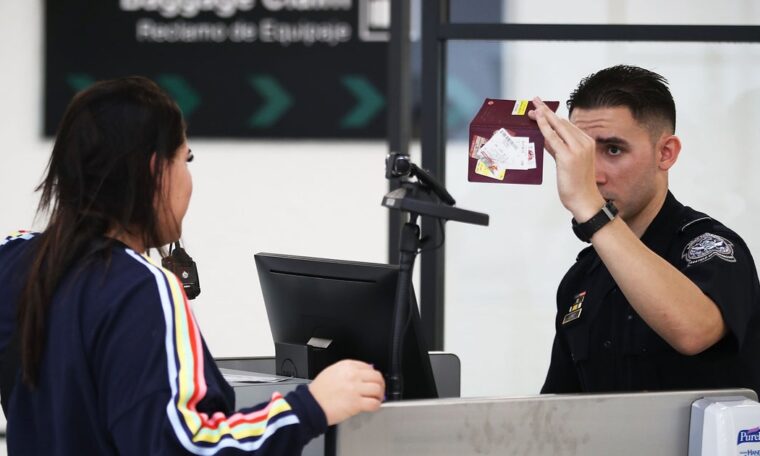
Joe Raedle via Getty Images
Under the new CBP proposal, foreign tourists would be required to share five years of social media history in order to enter the country.
As CBP already has the authority to seize and search digital devices, this proposed social media requirement raises even more concerns about privacy, free speech and discriminatory profiling ― particularly for those in “high risk” categories due to their nationality, religion or political expression.
“Borders are increasingly becoming spaces where governments test the limits of surveillance, often without democratic debate and public oversight,” Molnar said. “This policy shifts social media screening into a routine prerequisite for tourism, which is a profound recalibration of state power.”
Many experts also warned of a chilling effect on expression.
“Those who hope to experience the wonders of the United States ― from Yellowstone to Disneyland to Independence Hall ― should not have to fear that self-censorship is a condition of entry,” said Sarah McLaughlin, senior scholar for global expression at the Foundation for Individual Rights and Expression. “Requiring temporary visitors here for a vacation or business to surrender five years of their social media to the U.S. will send the message that the American commitment to free speech is pretense, not practice.”
This behavior does not reflect a country confident in the freedoms it offers to people, she added.
“Americans should not feel that they must silence themselves at home for fear that their online expression will bar their access to travel overseas,” McLaughlin said. “Therefore we shouldn’t put tourists coming here in that bind. Call it the golden rule of free expression: Treat the speech of visitors the way we want to see Americans’ expression treated abroad.”
Indeed, normalizing this kind of intrusive policy can also harm Americans in the long run.
“Five years of social media history is not about verifying identity,” Molnar said. “It is about monitoring beliefs and flagging people who may not agree with the current Trump administration’s policies. And once this kind of infrastructure exists, history shows it rarely remains limited to its original purpose.”
There are concerns about harm to the tourism industry, which is already facing reduced international visitors.
For the travel industry, the concerns are immediate: confusion, delays and a strong incentive for foreign tourists to simply choose other destinations.
“International tourism to the U.S. has already experienced an 8.2% decline in 2025,” said luxury travel expert and boutique consultancy founder Sarah Casewit. “This new proposed policy will only cause this number to go even higher in 2026.”
Indeed, the World Travel & Tourism Council previously found that the U.S. was already on track to lose $12.5 billion in international visitor spending this year.
“International visitors are core to U.S. tourism revenue, especially in cities like New York, Los Angeles, Orlando, Miami and Honolulu,” said travel writer Rocky Trifari. “I believe a requirement like this will create a sense of distrust among prospective travelers.”
Many visitors view social media as deeply personal, not as data to be packaged for government review.
“The idea of handing over five years of records to the United States government may feel invasive, less welcoming and ambiguous in how the data could be interpreted,” Trifari said. “Even if a traveler has nothing to hide, it might prompt anxiety and discourage spontaneous, leisurely trips.”
As tourism is fundamentally built on perception, the idea of added surveillance can influence how travelers view the U.S. as a destination.
“If even a small percentage of travelers choose alternative destinations with simpler entry requirements, the ripple effects could be significant,” Trifari said.
Indeed, many international tourists have already expressed unease with American digital surveillance practices. And a growing number of countries have also updated their travel guidelines and issued advisories for citizens considering a visit to the U.S. ― with many citing increased scrutiny from border authorities.
“The idea of handing over five years of social media history may feel like crossing a line, particularly for people who comment on politics, engage in activism or simply value their privacy,” Molnar said.
Several experts noted that travelers from regions with strong privacy regulations, such as the European Union, may take particular issue with the policy.
“They view social media as a personal space and not part of travel paperwork,” she said. “I believe the policy can deter visits particularly from young travelers, creatives, journalists and high net-worth individuals with concerns on privacy.”
If the administration’s proposed measures go into effect, Casewit predicts “a negative demand shock,” with reduced ticket sales, last-minute changes and overloaded airline phone lines.
“Hotels in major hubs such as attractions near Disney and National Parks will experience lower occupancy,” she said, adding that she recently had to cancel a group trip to Moab, Utah, due to concerns about the new policy. “Tour operators who rely on international visitors are already suffering from the drop in sales this year. This new policy will have a massive ripple effect on major events and sports tournaments as well, and will reduce the diversity of attendees.”
Major events could feel the effects as well. Experts have already raised concerns about whether the 2026 World Cup, which is expected to attract hundreds of thousands of international fans, might face reduced attendance if prospective visitors perceive the U.S. entry process as unusually intrusive.
“Tourism boards that have worked hard to rebuild momentum post-pandemic might face an uphill climb in reassuring travelers that the U.S. remains welcoming and accessible,” Trifari said. “Airlines may see decreased demand on long-haul routes. Hotels and tour operators who oftentimes already operate on tight margins could feel a measurable impact.”
There are also practical and logistical challenges.
Beyond economic and philosophical consequences, experts say the logistics of the plan are deeply problematic.
“The ESTA system was created to streamline travel,” Molnar said. “Instead, this proposal effectively turns it into a quasi-security clearance procedure. Some travelers may fear that old posts taken out of context or misunderstood could trigger denial of entry.”
She expects processing delays, inconsistent enforcement and general confusion about what constitutes “complete” disclosure.
“On a practical level, there are many issues that remain unresolved,” Casewit said. “Which accounts are relevant? How to provide deleted data? Are DMs included? It also points to a bigger concern, which is what points of view are being surveyed exactly? What content is used against the potential visitor? And what freedoms are they giving up for a trip to the U.S.? I expect an uptick in calls to consulates and travel advisors due to these ambiguities.”
Trips may then be postponed or canceled, as travelers decide to visit other destinations rather than deal with potential friction or slowdowns.
“Other countries do conduct digital screenings, but requiring five years of social media history places this proposal on the more aggressive end of the spectrum,” Trifari said. “Other nations sometimes ask for account identifiers or conduct passive checks, but a broad historical request is more extensive than the norm. In recent times, global trends have focused more on expanding access, streamlining travel, digitizing entry processes and reducing friction wherever possible.”
He emphasized that most destinations seem to be trying to make tourism easier, not more intimidating.
“This policy would be even more extreme than some of the requirements for actual visas I’ve seen in other countries,” said Clint Henderson, a travel expert at The Points Guy. “Some of the questions are very invasive ― like requiring the names, dates of birth, place of birth and address of loved ones. My big fear is that other countries react by making similar rules for Americans who want to travel internationally.”
He noted that this policy follows a slew of new rules from the current administration that impact travel to and within the U.S.
“It’s just more of an incentive for foreigners to skip America altogether, and more bad news for the U.S. travel industry,” Henderson said, pointing to the new $250 “visa integrity” fee, new $100 per person fee for visiting national parks, and more intrusive screening at borders.
“Making five years of social media mandatory for visa-waiver visitors is significantly broader than other countries’ requirements,” Casewit said. “It’s a demand that is more in line for long-term visas in high-risk categories.”
Tourists visiting the U.S. from visa-exempt countries previously underwent minimal screening, so the proposed requirements would be much more sweeping and invasive. Building a comprehensive digital portfolio for short-term visitors would be a rather unprecedented demand in the context of tourism and mainstream travel eligibility.
“Under the proposed changes, ESTA applicants could be assessed not just for identity verification but for perceived political beliefs, associations or dissenting speech, forming broader risk-assessments based on their online activity,” Molnar explained.
There are also concerns around the potential for error with these kinds of AI-enabled “risk assessments” and general data security and privacy.
“The execution risks creating more barriers, confusion and negative sentiment among international travelers,” Trifari said. “If implemented, I think it will be incredibly important for the U.S. to communicate clearly how the information will be used, who can access it, how travelers can prepare for the screening and how the history will ― or won’t ― impact entry decisions. Without this reassurance and information clearly communicated, the policy could unintentionally discourage the very tourism rebound that the U.S. has been working to restore.”
If entering the U.S. means surrendering your digital life to the scrutiny of border officials, then many tourists who have the choice to visit other destinations will likely opt to go elsewhere.
“I can appreciate the need to protect national security, but this policy proposal will trade accessibility and hospitality for surveillance and friction,” Casewit said. “It will turn a routine travel admin step into a privacy minefield. Besides the distrust this scale of surveillance will cause, it will prompt travelers to pick a destination that is less intrusive with its entry requirements.”
Source link
CHECK OUT: Top Travel Destinations
READ MORE: Travel News