
A century is barely a blink in the lifespan of our planet. Yet in 100 years, Sir David Attenborough has transformed public attitudes towards the natural world.
He’s captivated our attention with tales of Machiavellian chimps, pulled heart strings with scenes of a pilot whale clinging to her dead calf and even made us fall in love with his favourite insect – dragonflies.
A career spent filming in more than 300 locations across 83 countries, he has broadcast multiple mind-expanding wildlife interactions into living rooms, triggering a multitude of emotions.
No voice could better narrate stories of nature’s wonders.
And as the cherished TV presenter celebrates turning 100 today, here are some of the best ways to sample a fraction of the marvels observed throughout his lifetime.
RARE BIRDS IN SIERRA LEONE
Sierra Leone was the first destination Sir David Attenborough visited outside of Europe
A yellow-headed, rock-hopping bird carved out a career for TV’s greatest wildlife personality.
Venturing beyond European borders for the first time in 1954, a 28-year-old Attenborough headed for the forests of West Africa to find a bird that ‘no European that we knew of had seen alive in the wild’. The Picathartes gymnocephalus, or white-necked rockfowl, appeared in the first episode of Zoo Quest, filmed in the Gola Rainforest as part of a three-month expedition. The presenting gig sparked Sir David’s decades-long career in television.
Happily, it’s now far easier to reach the up-and-coming wildlife destination, praised for its avian attractions, on an eight-hour direct flight from Gatwick to Freetown.
Book it: A ten-night Sierra Leone Natural History Explorer tour costs from £3,425pp, including flights (rainbowtours.co.uk).
MADAGASCAN LEMURS
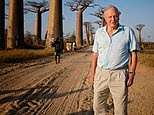
Sir David Attenborough among the boabab trees of Madagascar
Among the number of souvenirs collected on his travels, a giant elephant bird eggshell from Madagascar is one of Sir David’s most prized possessions. Initially reconstructed from fragments taped together using film canister tape, the peculiar treasure was acquired in 1960 during filming for the first-ever documentary on an island which he described as a ‘curious wonderland’ and an ‘unrepeatable experiment’.
Although the 10ft tall flightless bird became extinct in the 17th century, 60 million years of isolation and unique evolution have produced plenty of oddball plants and creatures including dancing sifaka lemurs, wasps that pluck tadpoles from tree-nests and a nano-chameleon the length of a match head.
Book it: Wildlife presenter Mike Dilger, from the BBC’s The One Show, leads a 14-day Madagascar tour from £8,995pp, excluding flights, on September 9, 2027 (wildlifeworldwide.com).
FIJIAN CULTURE
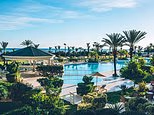
The Beqa lagoon in Fiji is not only culturally fascinating – it is also a true paradise, especially the Royal Davui Resort
Not all Attenborough documentaries have focused on animals.
Many of his early expeditions were ethnographic. Filming for The People Of Paradise on Beqa island in Fiji in 1960, he witnessed cultural practices at risk of extinction, such as firewalking across hot coals and sailing in double-hulled boats known as drua.
Set against a backdrop of dense rainforest, brilliant white beaches and secluded lakes, the presenter admitted: ‘There’s no people in the world that enjoy a big party more than the Fijians.’ Today, dances, ceremonies and artisanal crafts are on display at the newly reopened Damodar Arts Village in Pacific Harbour on Fiji’s main island Viti Levu.
Book it: An 11-day stay at the Royal Davui Resort in the Beqa lagoon and InterContinental Resort and Spa costs from £5,495pp, including all meals and flights (turquoiseholidays.co.uk).
WILD DOGS IN ZAMBIA
African wild dogs are the main attraction in the South Luangwa national park
Tracing the 2,000-mile course of the Zambezi River by boat, plane and foot took a BBC team almost four months in 1965. Faster journey times have allowed multiple visits since then, including filming for the TV series Kingdom.
Following the lives of four rival animal families of leopards, wild dogs, lions and hyenas, the epic tale of power and survival showcases the wonders of Zambia’s South Luangwa national park.
Used as a base by the film crew, the recently re-vamped eight-bedroom Olimba Camp overlooks the Luangwa River and a wildlife-rich lagoon. Combine this with the remote Nsefu Camp, built in 1951 by conservationist Norman Carr, for an ideal itinerary inspired by the series.
Book it: Six-night safaris from £5,533pp full-board, including flights (yellowzebrasafaris.com).
CASSOWARIES IN OZ
Cassowaries can be spotted Down Under, another spot visited by the intrepid explorer
For a man who’s travelled to all corners of the globe, picking a favourite spot is a tricky task.
Almost 70 years after his first visit, Sir David still considers the Daintree Rainforest, on Queensland’s Pacific coast in north-east Australia, to be the ‘most extraordinary place on Earth’.
Estimated to be more than 180million years old, it predates the existence of dinosaurs. One prehistoric creature that continues to roam in the dense mangrove swamps is the cassowary, a flightless 60kg bird with dagger-like claws and a running time faster than Usain Bolt.
Book it: A 13-day Birding In Queensland escorted tour costs from £6,795, excluding flights, departing October 12 (naturetrek.co.uk).
UGANDAN GORILLAS
For a gorilla sighting, head to the depths of Uganda to explore
Attenborough’s meeting with a baby mountain gorilla called Pablo was one of many touching highlights from Life On Earth in 1979 – footage of the apes pilfering his shoes remains one of his most famous clips and helped secure Sir David’s place as a national treasure.
New Netflix series A Gorilla Story shares the story behind the iconic moment. Although close-up cuddles with gorillas are forbidden today, it’s still possible to lock eyes with primates in Uganda’s forests.
Book it: A 15-day Wildlife Of Western Uganda Safari, including gorilla tracking in Bwindi Impenetrable Forest, is from £4,299pp (yellowwoodadventures.com).
GALAPAGOS HIGH DRAMA
Sir David has captured the beauty – and fascinating scenes – of the Galapagos
Proof the natural world can be just as gripping as any Hollywood blockbuster came in 2016: nail-biting scenes of racer snakes chasing a baby marine iguana in the Galapagos Islands had viewers clinging to the edge of their sofas.
What made the moment from Planet Earth II even more electrifying was Attenborough’s dramatic narration. Quashing accusations of fakery, Sir David insisted the footage captured ‘extraordinary animal behaviour which had never been witnessed or filmed before’.
Although glimpsing a similar encounter first-hand is highly unlikely, it is possible to find marine iguanas scrambling across the black lava flows of Fernandina island.
Book it: A ten-day trip on the Archipel I catamaran is from £4,875pp (explore.co.uk).
PAPUA NEW GUINEA ADVENTURE
Papua New Guinea has remote islands to discover with clear waters and animals galore
Greeting a group of cannibals was never going to be an easy task. But Attenborough approached the situation with aplomb while capturing footage of the Biami tribe for 1971’s documentary A Blank On The Map.
‘To say I was alarmed is putting it mildly,’ he revealed years later. But with typical British self-confidence, he simply waved and said: ‘Good afternoon!’
Returning to the remote islands in 2015, he had an equally dramatic but less ominous reception. In Attenborough’s Paradise Birds, an excited bird upstaged him by flapping its feathers in an aggressive display: ‘For me birds of paradise are the most romantic and glamorous birds in the world.’
Book it: A nine-day trip costs from £3,425pp (reefandrainforest.co.uk).
BORNEO FOR BATS
The Gomantong Caves in Sabah, Borneo are ideal for any adventurous explorers
Age does nothing to dampen an adventurous spirit, as demonstrated by the broadcaster when he returned to the Gomantong Caves in Sabah, northern Borneo, in 2014.
Hoisted 100 metres high inside the dark chamber, he hovered above cockroaches, bat excrement and a high concentration of ammonia gas to observe two million bats heading out for their nightly feed.
This ‘river of wings’ can be witnessed by tourists, along with orangutans – the endangered ape that first brought Sir David here in 1956 for Zoo Quest. See them at the Sepilok Sanctuary in Sandakan.
Book it: A ten-day Classic Borneo tour costs from £2,144pp (intrepidtravel.com).
BULL ELEPHANT SEALS
Bull elephant seals were involved in one of the most dramatic scenes captured by Sir David
Journeys to Antarctica, the coldest, windiest and driest place on Earth, may no longer be possible for the intrepid centenarian, but his legacy lives on through the RRS Sir David Attenborough – a British polar research ship now studying climate change and seafloor ecosystems.
One of his most memorable TV scenes involved a battle between two ferocious male bull elephant seals, a ground-thumping clash known as jousting. The activity takes place on South Georgia, in the South Atlantic, and can potentially be observed by ships visiting the island.
Book it: A 22-day Springtime In South Georgia, Falklands And Antarctica voyage on the 128-person MV Expedition costs from £13,179, departing October 22 (swoop-antarctica.com).
PUMAS IN CHILE
Head to the Torres del Paine National Park to see pumas in the flesh
A mother fighting to protect her cubs, Patagonian puma Rupestre emerged as a star of the 2022 Dynasties II series. While she died earlier this year, her screen presence ignited interest in puma spotting at Torres del Paine national park in Chile.
Crowds regularly cluster along roadsides for a sighting, but the nearby Cerro Guido Estancia remains chaos-free. The best way to view these cats safely is by joining a guided conservation tour led by the Cerro Guido Conservation Foundation, a project featured in the series.
Book it: A 14-day Chilean Patagonia: Torres del Paine & Beyond self-drive itinerary costs from £6,300pp (pura-aventura.com).
DORSET DINOSAURS
Closer to home, you can head to the Jurassic Coast in Dorset to find fossils
Of all the species that have ever existed on Earth, those locked in the past excite Attenborough most. ‘Fossils remind us that life is fleeting but nature’s record is for ever,’ he said, reflecting on a childhood passion for collecting ammonites.
The 150-million-year-old skull of a pilosaur – known as the ‘T-rex of the sea’ – found along Dorset’s Jurassic Coast was the subject of 2024’s Attenborough And the Giant Sea Monster and is currently on display at The Etches Collection Museum of Jurassic Marine Life in Kimmeridge, on the Isle of Purbeck. Once covered by tropical seas, this coastline is packed with fossils.
Book it: Doubles at The Pig on the Beach in Swanage from £235 B&B (thepighotel.com).
PEMBROKESHIRE PUFFINS
Sir David Attenborough, filming for Wild Isles, sat among the puffins on Skomer Island
Witnessing natural wonders doesn’t always require an expensive long-haul air ticket. The opening sequence to 2023’s British-based Wild Isles featured Sir David on Skomer Island, Pembrokeshire, surrounded by a colony of more than 40,000 puffins.
In preparation for scaling the 87 steps leading up from Skomer’s jetty, he practised walking up and down stairs at his home in Richmond, south-west London.
According to the Wildlife Trust of South and West Wales, recent counts show puffin numbers have risen by 20 per cent to more than 52,000 – meaning it’s almost impossible to miss them between April and July.
Book it: Unusual snorkelling experiences from £127pp, including boat travel, from Dale harbour and other locations on the Pembrokeshire coast (celticdeep.org).
GROUSE IN SCOTLAND
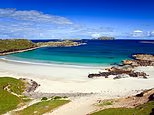
A capercaillie – also known as a grouse – is a common sight in Scotland
As charismatic as an emperor penguin and arguably more formidable than a silverback, the creature to keep Sir David on – or off – his toes is the western capercaillie.
Being literally bowled over by the world’s largest species of grouse was listed as one of his top wildlife moments.
‘He is so charged up – this being the breeding season – that he will display to almost anything, including me,’ Attenborough exclaimed at the time. The best place to find the shy but sometimes belligerent birds is in the coniferous forests of the Cairngorms National Park.
Book it: A five-night Rewilding Journey In The Cairngorms costs from £1,952pp, departing September 19 and October 3 (wildernessscotland.com).
COSTA RICAN SLOTHS
Attenborough’s visits to Costa Rica have seen the traveller cross paths with toucans and sloths
A master of words, the veteran TV presenter has an apt description for Central America’s cartoonish mascot mammals. In Life Of Mammals in 2002, he described rescued three-toed sloth Sonny, met in Costa Rica, as a ‘mobile compost heap’.
To demonstrate the creature’s laid-back reaction time, he shouted ‘Boo!’ into its ear. Fortunately, there were no visual displays of the tree-dwelling sloth’s preference for defecating once a week on the forest floor.
And there’s much else to see in this biodiversity hotspot, where nesting green sea turtles can be spotted between July and August in Tortuguero on the Caribbean coast.
Book it: A 14-night trip is from £3,650pp, based on a family of four, including flights (stubbornmuletravel.com).
WHALES OFF MEXICO
The massive blue whale, the largest mammal to exist, can be spotted off the coast of Mexico
Longer than school buses and equivalent in weight to 30 adult elephants, the blue whale is the largest animal to have ever lived.
No creature of that size could exist on land because its bones would not support it. While attempting to explain its scale during a boat trip through the Sea of Cortez off Mexico, Attenborough was dwarfed by an individual surfacing right below his tiny vessel.
Every winter, from February to March, an estimated 400 blue whales visit Baja California to feed and nurse calves.
It is also possible to find gray whales, humpbacks, sperm whales and many other species.
Book it: An 11-day Baja’s Ultimate Whale Safari costs from £8,195pp including flights (naturalist.co.uk).
Source link
CHECK OUT: Top Travel Destinations
READ MORE: Travel News