

Unesco heritage sites are usually the sorts of destinations you’d see on a guided tour itinerary – ancient palaces, historic monuments and natural landmarks.
But beyond the well-known sights are numerous weird and wonderful alternatives that have equally impressive Unesco status.
While these destinations might seem unusual to outsiders, many have fascinating histories and attract curious tourists keen to experience something completely different.
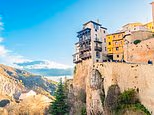
Whether it’s an alien-like landscape in Yemen or an unsettling cave in Spain, these are historic sites that are anything but ordinary.
Join us for a foray into some of the world’s weirdest Unesco heritage sites, including destinations in Germany, Canada and beyond…
Head-Smashed-In Buffalo Jump, Canada
First on the list is Head-Smashed-In Buffalo Jump, Canada
At this ancient indigenous hunting site, tribesmen would stampede bison over the cliffs – where they would plunge to their deaths.
Then, they could collect the carcasses at the bottom.
It is one of the best-preserved ‘buffalo jumps’ on earth.
Visiting means you’ll be walking along cliffs that were once covered in blood – and the site got its name from a legend, about a man who allegedly wanted to watch the hunt but got crushed by the stampede.
Unesco says: ‘The deep, undisturbed layers of animal bones (largely American Bison) represent nearly 6,000 years of continuous occupation with one lengthy period of unexplained interrupted hunting.
‘This landscape is an outstanding example of subsistence hunting that continued into the late 19th century and which still forms part of the ‘traditional knowledge base’ of the Plains nations. It throws valuable light on the way of life and practices of traditional hunting cultures elsewhere in the world.’
Nan Madol, Micronesia
Approaching the south east corner of the island of Pohnpei, in a lagoon, are 92 artificial islands, connected by tidal canals – this was once Nan Madol
Nan Madol was built as a city on top of a coral reef – it is a fascinating ancient floating city that has puzzled visitors for centuries, with questions surrounding how ancient builders transported materials across water.
Sometimes called ‘the Venice of the Pacific’, this megalithic stone city has drawn comparisons to mythic Atlantis – and even inspired horror writer H.P. Lovecraft as he wrote The Call of Cthulhu.
Archaeologists have long been in general agreement that Nan Madol rose to prominence from 1100 to 1628 AD, collapsing with the fall of the local Saudeleur monarchs in the 17th century.
The Saudeleur kingdom spent several centuries creating the intricate stone structures which still stand on 92 artificial islands in a lagoon off the coast of the island of Pohnpei in what is now known as the Federated States of Micronesia.
The name Nan Madol means ‘spaces between’ and is a reference to the tidal canals that crisscross the ruins.
According to the Smithsonian, the buildings that make up Nan Madol incorporate an estimated 750,000 tons of black rock.
Berlin Housing Estate, Germany
Berlin Modernism Housing Estates also have Unesco status
It might surprise you that a seemingly ordinary a collection of housing estates have Unesco status – but this collection of blocks in Berlin certainly does.
Built between 1910 and 1933, during a period of social upheaval, they are indicative of early 20th-century urban modernist design and architecture.
‘Designed by leading architects of German Modernism, they introduced innovative urban layouts, building typologies, flat-roof designs, technical solutions, and aesthetic approaches, while applying new social and hygienic standards aimed at improving housing and living conditions,’ Unesco explains.
‘Through their exceptional architectural and urban quality, the estates exemplify the housing reform movement that transformed residential design and established models for social housing in Germany and beyond.’
Stone Forest of Shilin, China
The Stone Forest or Shilin is formed of jagged limestone formations in Shilin Yi Autonomous County, Yunnan Province which feature coloured plants dotted among it
The Stone Forest of Shilin, China was formed around 270 million years ago.
Its jagged stone pillars have been thought to resemble a petrified forest rising out of the ground.
It is considered the quintessential stone forest worldwide, according to Unesco.
The pillars reach between 20 and 50m, creating an imposing ambience.
Socotra Archipelago, Yemen
The Dragon’s Blood Tree is one of the endemic species found on the island of Socotra
Socotra has been called one of the most alien landscapes on Earth thanks to its unique flora and fauna.
Located 155 miles east of Somalia and 210 miles south of Yemen, it lures adventurers with its sandy beaches, limestone caves and towering mountains, in addition to its unusual wildlife and vegetation.
The Dragon’s Blood Tree looks distinctive – and even bleeds a red resin when it is cut, giving it its name.
The island’s 40,000 residents remain somewhat of a mystery to the outside world as they have been isolated from modern society.
The Unesco World Heritage Site lacks proper tourist infrastructure but would otherwise be a haven for those who are into hiking, diving, surfing or wildlife spotting.
Fagus Factory, Germany
First up on the list is the Fagus Factory, located in Alfeld, Germany
Unlike traditional factories, Fagus was built in a modernist design with huge glass walls and an open aesthetic, rather than a traditional dark industrial style.
It is considered one of the first examples of Bauhaus style.
‘With its groundbreaking vast expanses of glass panels and functionalist aesthetics, the complex foreshadowed the work of the Bauhaus school and is a landmark in the development of architecture in Europe and North America,’ says Unesco.
It was designed in 1910 by Walter Gropius, with a focus on incorporating daylight into the building.
Wadi Al Hitan (Whale Valley), Egypt
Wadi al-Hitan, or the Valley of the Whales, boasts a fascinating collection of fossils
It is one of the driest regions of the world, receiving just a few inches of rain a year – but the remains of whales are emerging from the shifting sands of the Egyptian Sahara Desert.
The fossilised remains are helping to reveal how much of Egypt was once covered by a vast ancient ocean around 50 million years ago.
Known as Wadi al-Hitan, or the Valley of the Whales, the area contains the fossilised bones of an ancestor of modern whales which have fascinated tourists and palaeontologists alike since they were first discovered in 1902.
It is now set up as an open-air museum to show off the creatures that once swam over the area, 93 miles (150km) southwest of Cairo.
The Valley of the Whales in Egypt is home to some of the most remarkable palaeontological sites on Earth due to its unusual history.
Pamukkale, Turkey
Pamukkale – or ‘cotton castle’ – is a stunning series of calcium terraces, with mineral-rich pools tourists can bathe in
People have been coming to this weird and wonderful natural wonder in Denizli Province to bathe in its milky mineral-rich waters since Roman times.
Pamukkale (meaning ‘cotton castle’) is a series of 525ft-high stark-white calcium terraces containing pools that visitors can immerse themselves in.
At the top lie the ruins of the spa city of Hierapolis, which date back to 190BC.
Namib Sand Sea, Namibia
Stunning red sand dunes of the Namib Desert
Namib Sand Sea is the world’s only coastal desert with dune fields shaped by ocean fog.
Hikers come from all over the world to climb these constantly shifting structures, now popular tourist attractions, and take in the stunning view across the African plain.
Unesco says: ‘The desert dunes are formed by the transportation of materials thousands of kilometres from the hinterland, that are carried by river, ocean current and wind.
‘It features gravel plains, coastal flats, rocky hills, inselbergs within the sand sea, a coastal lagoon and ephemeral rivers, resulting in a landscape of exceptional beauty.
‘Fog is the primary source of water in the site, accounting for a unique environment in which endemic invertebrates, reptiles and mammals adapt to an ever-changing variety of microhabitats and ecological niches.’
Wieliczka and Bochnia Royal Salt Mines, Poland
There are 150 miles of subterranean tunnels across the mine, and visitors can explore the site through two different avenues – the tourist or miners’ route
Tucked away 1,073ft underground lies the Wieliczka Salt Mine – a salty kingdom located near the Polish city of Krakow.
The impressive site has more than 700 years of history and is spread across nine levels. It was once the largest source of salt in the country.
Salt extraction from the mine came to a halt in 1996. Although evaporated salt is still produced and collected, it now operates as a huge tourist attraction.
There are 150 miles of subterranean tunnels across the mine, and visitors can explore the site through two different avenues – the tourist route or miners’ route.
The tourist route allows visitors to ‘discover the secrets hidden deep underground’ and witness first-hand beautiful chambers, saline lakes and St Kinga’s Chapel.
Source link
CHECK OUT: Top Travel Destinations
READ MORE: Travel News