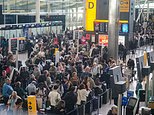

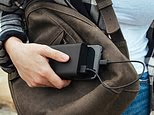
An easyJet flight heading from Egypt to London Luton recently made headlines after it was diverted due to a power bank in a passenger’s luggage.
The captain made the decision to divert the plane almost three hours into the flight, shortly after the passenger notified cabin crew they had a portable charger in use in the hold of the plane.
Some 20 minutes later, the aircraft landed safely at Rome Fiumicino and those on board were moved to a flight to Luton the following day at 2pm and provided with overnight accommodation.
But why would a small power bank cause so much trouble on a plane? The Daily Mail asked industry experts for their take.
Seamus McCauley, head of public affairs at Holiday Extras, explains how the real ‘danger is thermal runaway’ in power banks.
This refers to ‘a self-sustaining chain reaction inside a lithium-ion battery that can produce intense fire in the sealed, pressurised environment of an aircraft cabin, and in the hold, where crews lack immediate access, a fire could go undetected until it is already serious’.
McCauley says, ‘Our advice to travellers is simple: know the rules before you fly, keep your power bank in your carry-on where crew can see it, and never put it in checked luggage. A few minutes of preparation before you leave home is a small price to pay for everyone’s safety in the air.’
Gavin Lapidus, company director at eShores, an online travel agent and tour operator, reveals how during a thermal runaway, ‘a lithium‑ion battery undergoes an uncontrollable self-sustaining chemical chain reaction that leads to extreme heat generation (often reaching 600°C to 1000°C)’.
An easyJet flight heading from Egypt to London Luton recently made headlines after it was diverted due to a power bank in use in a passenger’s checked luggage
He adds, ‘The reaction releases toxic flammable gases and involves a high-risk of fire or explosion.’
A fire in the cargo hold is ‘typically more dangerous and harder to control than cabin fires’ due to how inaccessible the area is, hence why power banks are usually not permitted there.
In the hold, ‘detection is often delayed, and the contents may include unknown highly flammable materials. As a result, cargo hold fires can escalate significantly before they are discovered posing a risk to everyone on board,’ Lapidus adds.
Power banks are more prone to overheating or setting on fire compared to other lithium-ion-powered devices, mostly ‘due to manufacturing quality variability and user handling’.
‘Despite sharing the same core battery technology as consumer electronics like smartphones and laptops, power banks are typically less tightly regulated, more commonly purchased as inexpensive unbranded products, and more likely to experience rough handling,’ Lapidus explains.
Power banks have been known to set on fire during flights, including on a KLM plane last year.
Passengers were thrown into a panic when a portable phone charger caught fire halfway over the Atlantic Ocean.
The chaos erupted on Flight KL792 from São Paulo to Amsterdam in August while most passengers were sleeping, according to Brazilian journalist Simone Malagoli.
Gavin Lapidus, company director at eShores, says a power bank fire in the cargo hold is ‘typically more dangerous and harder to control than cabin fires’
Malagoli, who was on the aircraft, said the flight was four hours away from landing when the portable charger burst into flames.
Flight attendants responded quickly by putting out the fire with extinguishers, the airline said in a statement at the time.
What do authorities say about power banks?
Jonathan Nicholson from the UK Civil Aviation Authority (CAA) told BBC News that ‘more awareness’ regarding portable charges and their risks is needed.
He outlined a ‘basic set of international rules’ and advised passengers should take power banks on board planes and not put them in checked luggage.
A maximum of two power banks per passenger should be permitted and Nicholson argues once on the plane, ‘absolutely do not charge the power bank itself because that’s when they become really hot and most susceptible to having an issue’.
The CAA updated its conditions regarding power banks earlier this year.
Its ‘Technical instructions for the safe transport of dangerous goods by air’ outlines how the technology ‘must be carried as carry-on baggage’ and ‘must not be recharged while on board the aircraft’.
Power banks also ‘should not be used to recharge a portable electronic device while on board the aircraft’.
The regulation continues, ‘no more than two power banks may be carried per person; and must be individually protected so as to prevent short circuits when not in use (by placement in original retail packaging or by otherwise insulating terminals, such as by taping over exposed terminals or placing each power bank in a separate plastic bag or protective pouch)’.
Meanwhile, the UK Foreign Office urges passengers to ‘Check the restrictions or contact your airline if you’re not sure what you can carry.’
Power banks have been known to set on fire during flights, including on a KLM plane last year (stock)
Airline rules
EasyJet
The airline’s website states the devices ‘are accepted on easyJet aircraft with a Wh rating not exceeding 160Wh for lithium batteries’.
They are permitted in cabin baggage, but not the hold, and ‘are prohibited from use on easyJet aircraft and must not be used to charge other devices’.
‘Power banks must be individually protected i.e. placing in original retail packaging or a plastic bag,’ the regulation continues.
Customers are limited to carrying up to two each. The airline outlines, ‘Power banks must be carried in carry-on baggage only and it is recommended that power banks are carried where they can be monitored i.e. on your person.’
Ryanair
The budget airline allows passengers to carry up to 15 personal electronic items in the cabin, including smartphones, tablets, laptops, cameras, handheld game consoles, headphones and power banks.
Its website also states, ‘You may also carry up to 20 spare lithium batteries or power banks, provided they do not exceed 100Wh each.’
But, devices or batteries that are over 100Wh are not allowed in either the cabin or the hold.
Passengers are not allowed to use power banks and spare lithium batteries to charge portable electronic devices during taxi, take-off or landing.
They should also not be stored in the overhead lockers and should instead be placed in a small cabin bag under the seat in front, or on your person.
British Airways
Power banks and spare batteries of up to 100Wh must be kept in hand baggage only for British Airways’ flights.
Travellers may only take up to two power banks per person and the device must display capacity rating information.
‘Aircraft seat power supplies are to be used exclusively for charging personal electronic devices (PEDs), not power banks,’ the airline states.
They must also be stored in a bag under the seat in front or in the seat pocket.
Airlines each have their own regulations on power banks, and British Airways only permit up to two per passenger
Jet2
Jet2 states power banks must only be carried in cabin baggage, and should be stored underneath the seat.
‘Power banks and articles which have a primary purpose as a power source are considered as spare batteries and can only be carried in cabin baggage under your seat,’ the airline states.
‘They must not be used during taxi, take-off, or landing; however, they may be used onboard at other times if monitored (i.e. on your tray table).’
Damaged power banks are forbidden on board, and the device must have its watt-hour rating or lithium content visible.
TUI
For TUI flights, power banks must not exceed 100 Wh and can only be brought in carry-on luggage, with a limit of two per person.
The tech is not permitted inside checked baggage and passengers cannot use the power bank to charge other devices during any phase of flight, or charge itself on board.
They must also ‘be placed under the seat in front or in another designated area such as the seat-back pocket,’ according to TUI.
Other tricky items for planes
TENT PEGS: Though they may be essential for a camping trip, sharp items such as tent pegs are not allowed in hand luggage and instead may only be carried in the hold, according to the CAA.
FIREWORKS: Fireworks are banned from both the hold and cabin luggage.
GUNS, INCLUDING TOYS OR REPLICAS: Any item that resembles a firearm is not permitted on a plane.
SNOWGLOBES: They are typically over 100ml and are not usually marked to show how much liquid they contain so generally won’t be permitted in hand luggage, and are best suited for checked luggage if carefully wrapped.
HAIR DYE: Hair dye is not permitted in either hand luggage or the hold as it often contains peroxide.
SOUP: Hand luggage liquid allowance stands at 100ml, and a tin of liquid soup is usually well over the limit.
SOFT CHEESE: Soft cheese counts as a liquid, so to take on board in carry-on luggage it must be within the 100ml limit.
DRILLS: If you plan on doing some DIY when you arrive to your destination, sadly drills and drill bits are not allowed in hand luggage. But, the tools are permitted in the hold. The same goes for saws, screwdrivers, hammers, pliers, and wrenches and spanners.
FROZEN BREAST MILK: Passengers are not permitted to take frozen breast milk in hand luggage, but it is allowed in the hold.
Source link
CHECK OUT: Top Travel Destinations
READ MORE: Travel News