

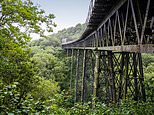
From Grade-II listed structures to one unique-looking iron bridge nicknamed ‘The Spider Bridge,’ the UK has plenty of impressive constructions that are no longer in use.
Graeme Bickerdike’s new book, Railway Wonders, delves into many of the abandoned viaducts and railway tunnels across the country.
Some have been completely discarded and left to crumble, while others have been repurposed for walking and cycling routes in scenic landscapes.
In the book, out now and available to buy online, Graeme writes: ‘This is not a book of the 100 most impressive stone-arched viaducts, however awe-inspiring that might be.
‘What’s been brought together here is a collection of structures with a fair geographical spread (noting that the choice is limited in the east, south and south-east of England), varied building methods or noteworthy engineers, and eye-catching stories from their construction, operational and redundancy periods.
‘A handful of the featured viaducts have substantially been lost, but there will always be some physical remnant to fire the imagination.’
Read on to discover some of the best historic railway tunnels and viaducts in the UK.
Wylam Bridge
Wylam Bridge consists of three wrought iron lattice arches and now provides a path through Tyne Riverside Country Park
Wylam Bridge broke boundaries when it was first constructed in 1876, making it what was thought to be the first of its kind able to carry the load of a railway.
It stands as a single-span bridge, with no supporting piers underneath – unusual for the time.
At 282 tons, the bridge consists of three wrought iron lattice arches, painted a striking white – which Northumberland County Council spent £224,000 retouching back in 1997.
Despite being closed down for use in 1968, Wylam Bridge once saw two train tracks run across it. With the train lines now removed, it now sits as a Grade II listed structure and serves as a path through Tyne Riverside Country Park.
Meldon Viaduct
Meldon Viaduct impressively survived a fire and an expansion before train services across the route were withdrawn in 1968
Now a scheduled monument, this eerie iron structure once nicknamed ‘The Spider Bridge’ by locals provides a route through Dartmoor.
It was once a railway viaduct and was built in the 1870s, Meldon Viaduct survived a fire and an expansion before train services across the route were withdrawn in 1968.
The viaduct now provides a cycle path across Dartmoor and The Granite Way.
Tidenham Tunnel
Tidenham Tunnel was constructed back in 1874 by local miners
Located in South West England, Tidenham Tunnel was constructed back in 1874 by local miners who completed the railway structure in less than 20 months using Ingersoll rock drills.
Many people were injured and even died during the build and when finished, it stretched across 1,129 yards and was eventually joined with a separate second tunnel to make a singular, longer route.
The tunnel closed down for passenger services in 1959 and continued to be a track for goods trains until 1964.
Carriages for Tintern Quarry used the tunnel until the end of 1981 and the track was removed completely in 2019.
It’s now covered with tarmac and opens for pedestrians to pass through on foot or bike between April and September.
Lady Wimborne’s Bridge
Lady Wimborne’s Bridge, in Dorset, boasts intricate carvings and brickwork
An ornate structure with intricate carvings and brickwork, Lady Wimborne’s Bridge can be found in Dorset.
The impressive bridge consists of limestone ashlar and was built in 1855 to provide a route for London and South Western Railway to cross over Canford Manor’s, now Canford School, private drive.
One of the most intricately decorated bridges in the country, Railway Wonders describes it as ‘a monument to the aristocracy’s willingness to demonstrate its wealth through architectural embellishment’.
Conisbrough Viaduct
Conisbrough Viaduct was built by Dearne Valley Railway in 1909
Described as an ‘immense structure’ by Bickerdike, Conisbrough Viaduct was built by Dearne Valley Railway in 1909.
Located in South Yorkshire, it took 250 men and 15 million bricks to build, as well as 2,000 tons of cement.
Conisbrough Viaduct stands 116 feet above the River Don and all railway services across it were suspended by 1966.
It has never been demolished because of the high cost to do so and instead is looked after by Railway Paths charity.
Grace Dieu Viaduct
Surrounded by trees and greenery, Grace Dieu Viaduct boasts six tall arches built with red brick
Swamped by greenery and woodland, Grace Dieu Viaduct has six tall arches built with red brick.
Located near the remains of the 13th Century Grace Dieu Priory, the viaduct now stands disused and instead of trains rushing over its tracks, instead has ivy winding up its walls.
It shut down from passenger use in 1931 and closed to goods in 1963, left barren ever since.
Hownes Gill Viaduct
Hownes Gill Viaduct was built back in 1857 and is now a Grade-II listed structure
Peeking over trees and woodland in County Durham is the Hownes Gill Viaduct, for which construction began back in 1857.
Now a Grade II listed structure, it boasts 12 arches that are each 50 feet wide and is now part of the Waskerley Way Railway Path.
Built with stability and longevity in mind, the viaduct is supported by piers and ‘stepped buttresses,’ as well as inverted arches.
The route was shut down in 1969 but is now regularly used by passers by, and it has a tall, curved metal fence all along it.
Oxendon Tunnel
One of the tunnels is now open for walkers to peer up at its curved brick walls and archways
Located in Northamptonshire, the Oxendon Tunnels saw their last train trundle through in 1981 – over a century after they were built.
One of the tunnels is now open for walkers to peer up at its curved brick walls and archways.
In one section there is a shaft that allows light to pour down onto the floor where the train tracks used to lie. Other tunnels are still closed off.
Shankend Viaduct
Shankend Viaduct, located near the Scottish Borders, went through numerous repairs during the viaduct’s working life
Stretching across 15 arches, the Shankend Viaduct overlooks rolling hills in the Scottish Border and is described as the Waverley line’s ‘greatest engineering feat’ according to Bickerdike.
It was built back in the 1860s but experienced structural problems throughout much of its use.
Battling heavy loads and undesirable weather conditions, it also went through numerous repairs during the viaduct’s working life.
It now stands unused, and Bickerdike describes it as looking ‘scruffy’.
Wickham Bishops Viaduct
Wickham Bishops Viaduct now stands in the water surrounded by overground woodland and is out of use
Although it may appear to be a simple structure compared to the towering brick structures you may see in the countryside, Wickham Bishops Viaduct should not be overlooked.
Two viaducts were built to carry the Witham to Maldon line over the River Blackwater in the 1840s.
Now standing in the water surrounded by overground woodland and out of use, they are the last surviving timber trestle viaducts in England after being restored by Essex County Council in 1995.
Railway Wonders, by Graeme Bickerdike, was published on March 15, 2026 and is available to buy now
Source link
CHECK OUT: Top Travel Destinations
READ MORE: Travel News