

Today marks 100 years since Antoni Gaudi died – and Pope Leo XIV will be opening the finally completed new tower of the Sagrada Familia Basilica in Barcelona to celebrate.
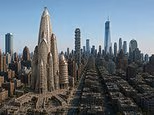
But, while the Sagrada Familia is his most famous landmark, Gaudi was also commissioned to design a 360-metre skyscraper hotel in New York in 1908, named Hotel Attraction.
Two businessmen from the US reportedly visited Gaudí in Barcelona, asking him to design a majestic hotel in Lower Manhattan.
The hypothetical result would have featured towers, stained glass, mosaics, themed halls, museums, restaurants, residences, Fobservation spaces and a giant star on top.
It would have been taller than the Eiffel Tower, the then-world’s tallest structure. The Empire State Building was still more than two decades away.
But alas, the building never came to fruition.
In a video titled What if Gaudí’s Hotel Attraction had been built in New York?, Daniel Coughlin explores what this impressive structure would have looked like.
The video, from channel The Curious Compendium of Architectural What-Ifs, reveals AI images of Hotel Attraction, aiming to create the most faithful visual impression of what the building would have looked like.
Gaudí’s Hotel Attraction project could have been a magnificent addition to the New York skyline
Features would have included a star at the peak of the building, as well as other Gaudi-style designs such as mosaics
The images use inspiration and information from Gaudí’s built and unbuilt work, including Casa Batlló, Casa Milà, Colònia Güell and the Sagrada Família.
They are also based on academic work and virtual reconstruction research from the Technical University of Madrid.
For the film, the building is shown on Church Street in Lower Manhattan, near the World Trade Center area and not far from 56 Leonard, the ‘Jenga Tower’.
No exact site can be confirmed.
Hotel Attraction’s design is focused on a huge tapering main tower, and would have felt like a blend of a luxury hotel, monument and cathedral, the filmmaker explains.
Descriptions point to materials including iron, concrete, aluminium, brick, stone and marble.
The façade was set to be covered in trencadís, Gaudí’s signature broken ceramic mosaic.
The main doorway was set to be topped by an American imperial eagle
Very few original Gaudí sketches remain, but one shows the outline of the skyscraper
The colouring may have been earthy near the base, with greens and browns turning into warmer reds – and with silver and gold near the top.
The reconstruction also includes neo-Gothic turrets, glazed domes and stained glass windows.
The interiors are no less impressive.
The skyscraper was planned with four imposing entrances, including a main doorway topped by an American imperial eagle.
A reception hall would be up to 17 metres high, while five underground floors would contain kitchens, garages, machinery and service areas.
The lower towers would house suites and residences.
A Europa Hall was intended as a restaurant and event space, with an ornate ceiling featuring a starry medallion, mythological figures and emblematic plants of Europe.
The Orient Room would be Gaudí’s homage to Asia, with massive columns – reminiscent of a temple.
The Europa Hall interiors would have been impressive, with mythological figures on the ceiling
The crown jewel would have been the vast Orient Room
The climax would be the Tribute to America Hall: a vast light-filled chamber rising around 125 metres.
It planned to include a 10-metre replica of the Statue of Liberty, statues of the Founding Fathers and more visual tributes to the US.
Near the top of the building, an observation deck was planned.
Even though it was never built, Hotel Attraction has fascinated architects, writers and scholars.
For instance, it was proposed as a memorial skyscraper for the World Trade Center site after the 9/11 attacks.
Meanwhile, the design inspired the 2026 Attraction watch collection by luxury watchmaker Lebond.
But the tower remains mysterious – almost everything known about the project comes through Joan Matamala, the son of one of Gaudí’s sculptors.
Matamala claimed that in 1908, when he was 15, he saw or heard details of a secret New York hotel project in Gaudí’s workshop.
However, there are doubts as to the authenticity of the designs left by Gaudi and his contemporaries, and lack of supporting documentation.
But regardless of the uncertainty, some have argued the Hotel Attraction is too structurally and symbolically reminiscent of Gaudí to be cast aside.
Source link
CHECK OUT: Top Travel Destinations
READ MORE: Travel News