

For many Brits, a train journey means standard carriages, familiar views and, if you’re unlucky, a cup of decidedly watery coffee.
But venture beyond the UK’s tracks and rail travel takes a decidedly bizarre turn.
From trains that hang upside down and glide through tower blocks to bamboo platforms hurtling across the Cambodian countryside, engineers around the world have come up with some truly extraordinary ways to get from A to B.
Whether it’s a futuristic monorail in China, a hair-raising ride up a Swiss mountainside or a train journey across the vast Mauritanian desert, these are railways that are anything but ordinary.
So, all aboard for a journey through the world’s weirdest trains – but how many would you ride?
Wuppertal Schwebebahn, Germany
Up first on the list is the Wuppertal Schwebebahn, Germany
The suspension railway in Wuppertal, Germany, isn’t a traditional monorail, as it hangs from the track, elevated above the city.
The system’s inventor, Eugen Langen, originally pitched the idea to Berlin and Munich but both cities rejected it.
He found interest in Wuppertal, and nowadays the city’s system carries 80,000 people per day and attracts tourists to the area.
The vehicle runs for 13km (eight miles) through the city, stopping at 20 stations, and just last month celebrated the 125th anniversary of the suspension railway with a family-friendly festival in Wuppertal.
Bamboo Train (Norry), Cambodia
Bamboo Train (Norry) in Cambodia is both transport and tourist attraction
Cambodian ‘bamboo trains’ are improvised open-air transport that you can find in Battambang.
These trains are the travel solution along several stretches of partly wrecked Cambodian track. Here proper trains no longer run – so locals made their own.
The trains are made in local workshops, as are the trains’ flatbed trucks – bamboo platforms called ‘Norry’, which carry passengers, livestock, rice and market goods.
Reaching speeds of up to 50km/h (31mph), the mode of transport is a popular tourist attraction.
DMV Dual-Mode Vehicle, Japan
The DMV in Japan is unique because it converts from bus to train in just seconds
This dual-mode vehicle, or ‘DMV’ for short, can transform from a road-going bus to a track-travelling train in just 15 seconds thanks to steel wheels that can be lowered onto the track at the press of a button.
This ‘mode interchange’ goes into reverse when returning to the road, with the steel wheels retracting so the rubber tyres can take the lead.
The DMV can carry 23 people – including the driver – and measures around eight metres (26ft) in length. It weighs just 5,850kg (5.85 tons), making it significantly lighter than a regular train carriage.
On the tracks, it can travel at speeds of 60kmph (37mph), but on the road, it can go faster, depending on the speed limit.
Stoosbahn, Switzerland
Up next is the hair-raising Stoosbahn, located in Switzerland
The Stoosbahn takes tourists 6,000ft above sea level to or from the Gelmersee Lake, and while the journey might be slow, it’s not for the faint-hearted.
Open carriages take 24 passengers up the steep cliff face from Handegg, in Hasli Valley, on a scary but scenic ride lasting about 12 minutes.
Thrill-seekers have little more than a red metal bar to cling to as the cable car slowly makes its way down the mountain.
It’s the world’s steepest funicular railroad – equal parts stunning and terrifying.
Tren Solar de la Quebrada, Argentina
Tren Solar de la Quebrada in Argentina is up next
Tren Solar de la Quebrada is Argentina’s first solar train, which takes passengers through a 42km (26 miles) route that traces historic villages dating back 10,000 years.
Travelling at 33km/h (21mph), it’s not a speedy journey, but it is especially picturesque.
Explains Visit Argentina: ‘This is the first solar train in Latin America, 100 per cent sustainable, with lithium batteries and solar charging, taking you through a universe full of magic, amidst picturesque towns and incredible characters.’
Ferrobus, South America
Ferrobuses in South America are a mashup of a bus and train
A ferrobus is a hybrid vehicle that’s built from a bus but is mounted on steel train wheels so it can navigate narrow railway tracks.
They are mainly found in Bolivia and Chile, and often run in high-altitude areas.
The Gondola Carril in Chile, for instance, is an old 1920s bus that has been converted to run on a railway track, and is a tourist attraction for many visiting the region.
Chongqing Monorail, China
Chongqing’s monorail is the largest in the world
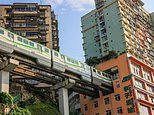
Chongqing’s monorail was opened in 2005 and can carry 30,000 passengers per hour. It’s the largest monorail system in the world and – bizarrely – even travels through a building.
The Liziba Station is situated between the sixth and eighth floor of a 19-storey high-rise block. While some of the building’s lower floors serve as the station, others are actually flats and residences.
It might seem like curious urban planning, but the building and the station were built at the same time and the flats are equipped with noise reduction systems to reduce the sound of the monorail.
Devil’s Nose Train, Ecuador
The Devil’s Nose Train, Ecuador, zigzags up and down the mountain
The ride is considered one of the world’s most dangerous train rides due to its route on an overhanging cliff that drops hundreds of feet as well as winding turns and steep incline.
According to the Ecuador Rail’s website, the feat of engineering got its nickname ‘because of the many deaths among the workers that occurred there and the sheer difficulty of building it’.
Nowadays, it’s popular among tourists, with a 2.5-hour round trip taking you zigzagging up the mountain – which is far too steep for a train to ascend directly.
Optics Valley Photon Air Rail, China
China’s first commercial suspended monorail is found in Wuhan
Wuhan became a household name when the Covid-19 pandemic broke out – but since then, the establishment of this train in 2023 has brought far more positive news to the region in China.
The Optics Valley Photon Air Rail is China’s first commercial suspended monorail, and hangs upside down, with glass floors providing views of the scenery below.
The driverless trains operate with between two and six cars, and each can carry up to 200 people.
Pokémon With You Train, Japan
Next up on the list is the Pokémon With You Train, Japan
‘The POKÉMON with YOU Train brings smiles to children’s faces as it takes them on a journey through the region once devastated by the Tohoku earthquake and tsunami of 2011. Pikachu can’t wait to meet you and your family!’ says the JR East train website.
Inside, you’ll find seating, a playroom and a giant Pikachu relaxing on the floor.
Pikachu decorates the inside and out of the train, and passengers will also receive a commemorative notebook and boarding pass in keeping with the theme.
Iron Ore Train (Mauritania Railway), Mauritania
Topping off the list of the strangest trains around the world is the Iron Ore Train in Mauritania
Join the discussion
What’s the wildest train ride you’ve ever taken, and did it live up to the hype?
The world’s longest iron ore train is a 1.2 mile monster that travels Mauritania’s only railway line.
It travels a distance of more than 700km (435 miles), linking the mining town of Zouérat with Nouadhibou, the country’s second-largest city and main Atlantic port.
Its main purpose is transporting freight.
However, there is a passenger section available on board. Most travellers hopping on the Iron Ore Train take the daredevil route – jumping on top and watching the desert go by.
In recent years, it has faced crackdowns by authorities due to the risks involved but thrill-seekers are still keen to jump on board.
Source link
CHECK OUT: Top Travel Destinations
READ MORE: Travel News