
My grandmother, pointing at curious two-inch long cutlery stands on the table, exclaims: ‘Mother had those.’
We are in Riga’s Art Nouveau Museum, touring the apartment of a wealthy former resident – and we are on a mission. My grandmother Marlene (known by all as Moen) and I have travelled to the Latvian capital to trace our family roots.
I, like Moen, was born in Johannesburg, but our family originally hails from eastern Europe. Three months ago, I took a DNA test through MyHeritage, an online genealogy company, that opened a can of worms.
Although I knew my Ashkenazi Jewish family had its origins in Lithuania, Latvia and Poland, I had always been unable to uncover any real details beyond anecdotes.
My results, however, revealed I am 98 per cent Ashkenazi Jewish and that before the turn of the 20th century my family largely came from Latvia.
On discovering this, I immediately called Moen, my only grandparent with recollections of our Baltic ancestors.
‘My mother came from Riga, ’ she said. ‘She never spoke about it – all I know is she said it was a beautiful city with a university.’
I had heard loose references to my great-grandmother, Vera Trembatzki, but never anything concrete, even though I am named after her (my middle name, Deborah, is derived from the root of hers).
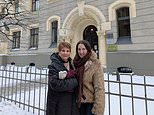
On a mission: Writer Erin and her grandmother, known as Moen, started their journey in Riga
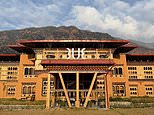
Notes of nostalgia: Riga’s Art Nouveau Museum conjured up familial memories
Vera, for me an almost fictional character, grew up in Latvia and emigrated to South Africa just before the Second World War.
I asked Moen if she wanted to join me in Latvia to see what we could unearth. At first, she was reluctant. She was adamant she would not feel a connection to Latvia, her mother’s avoidance of dwelling on the past perhaps a symptom of a traumatic departure.
But while Moen and I have always been close, we have rarely enjoyed the gift of much time together. The promise of five days was special, though… and enough to convince her.
And we happen – apparently – to be fitting into one of travel’s hottest trends for 2026, tracing our roots and spurred on by TV shows such as Who Do You Think You Are?
It’s all the rage for 2026, says the influential Conde Nast Traveller magazine. Which is how we arrive in Riga in -12C conditions on a snowy January afternoon. Moen, who has always lived in South Africa, has never seen more than a dusting of snow.
We get to business. MyHeritage has uncovered a wealth of archives plus I’ve printed photographs, family trees and old letters. The images are uncanny. Vera looks like Moen and I do a double take at my great-grandfather Solomon Samuelson – he could be my brother.
Combined with snippets Moen recalls, we pour over them, concluding that Vera met Solomon in 1930s Riga. Vera’s eight siblings left for Paris shortly thereafter. Solomon, meanwhile, took the boat to South Africa, where she joined him.
Naturally, seeking Vera’s home is our first priority. We begin at the Art Nouveau museum with our guide Andra Brice.
Family resemblance: Vera Trembatzki, Erin’s great-grandmother, grew up in Riga
As we explore the intricate items on display, Moen becomes increasingly excited. In the bedroom, it’s the hat boxes atop the wardrobe she can’t stop looking at. In the kitchen, it’s the embroidered tea towels, while in the dining room, mini cutlery stands catch her eye. Even the lace curtains feel familiar to her.
‘I feel like I’m dreaming, ’ Moen keeps uttering, as though her early childhood days have come rushing back.
After this, we leave to try to find Vera’s real apartment. All we have is a photograph from our Parisian cousins – the place might not still exist. We head to the Museum of Jews in Latvia and, while it’s interesting, we’re disappointed there is no reference to a Trembatzki or Samuelson family. Staff, however, inform us the apartment is on the same street. We are in the heart of what was the Jewish quarter a century ago.
Energised, guide Andra – who has continued with us – asks ChatGPT to give us a full address from assessing the image. ‘Skolas Iela 20’ , it reads. We head straight there, but on arrival the location is clearly incorrect.
We pace along the boulevard, looking for a grey building in the hope of a match. An hour and three wrong stops later, we can’t feel our toes from the cold.
Andra suggests we check the courtyards behind the main street. One looks promising, and Moen thinks we’ve found it, until I point out the windows are wrong. I can feel her frustration.
Spurred on, we power through blankets of snow. Still nothing. Returning to our car, Andra asks our driver Raitis to drive slowly around the area. He kindly obliges – and he asks what we’re looking for. I pass him the old picture.
‘You’re looking for the kebab shop?’ he asks. We are in disbelief. So simple. Raitis hurtles down the street at full speed.
When in Riga: Sightseeing was also on the agenda, including the famous House of the Black Heads
Winter wonderland: In January, the city was covered with a thick blanket of snow
Moen is vibrating with anticipation. I leap out of the car.
It’s here, ’ I shout. The building has the same door as the photograph, marked ‘1913’.
It’s an emotional, deeply satisfying, moment. Moen breathes it all in and she whispers: ‘I feel her spirit here.’
Going back to a place that once ousted a Jewish community feels like a feat of defiance.
The exact reason for Vera’s departure remains cloudy. Officially, it was due to work opportunities in Johannesburg yet I can’t help but wonder if growing anti-Semitic sentiment had something to do with it.
For the remainder of the afternoon, Andra takes us round a number of sights in Riga – the three of us on a high.
Looking to arouse nostalgia, I ask Moen what her mother cooked when she was growing up. ‘Chopped herring, borscht, cucumbers in saltwater, ’ she replies. Moen is excited when we spot these in markets, but Andra suggests we also taste Riga’s modern cuisine.
Highlights are seared tuna at Kolonade Our Stories and mushroom soup at Kalku Varti. At breakfast the next day, we forgo chopped herring for croissants.
Eureka! Erin and Moen, almost by accident, found the building in which Vera grew up
History in the flesh: The building, while showing signs of wear, appears much as it does in old photographs
The seared tuna at Kolonade Our Stories restaurant is a culinary highlight of the trip
Moen and I debrief in our hotel on our final night in Riga. She begins to speak of the cutlery stands we saw at the museum.
‘That apartment brought back memories. It aroused something in me, ’ she tells me.
Then she tears up: ‘My mother has been gone for 50 years. But today, I missed her.’
However, we are not finished with these grandmother-granddaughter heritage investigations.
In 1963, Marlene Samuelson met Michael Waks at a bus stop in Johannesburg. They married four years later and had three children.
Somehow, we learn, the Waks and Samuelson/Trembatzki families, who crossed paths 10,000 miles from Latvia in Johannesburg, are originally from cities just 125 miles apart: Riga and a place I’ve never heard of, Liepaja, a port city on the Baltic Sea.
I have a family photograph taken in 1889 in Liepaja that includes my greatgreat-great grandparents. Raitis drives us west to explore.
It’s a jarring city. Ornate golden churches rise glimmeringly behind ugly grey apartment blocks redolent of Soviet times.
We remember: Liepaja’s Jewish Cemetery includes a Holocaust memorial to victims
Your browser does not support iframes.
A walking tour takes us past homes formerly owned by Jewish families to a Jewish cemetery. We are entranced as we read the list of burials – and many of our ancestors appear.
My family survived the Holocaust by emigrating to South Africa but it is impossible for us to visit Latvia without understanding this dark period of history.
We visit Skede Holocaust Memorial, and I’m not certain whether Moen’s tears are from the cold or something else. The mass graves need no explanation.
Unsurprisingly, the Jewish community in Latvia is greatly diminished today. The 1940s saw an end to the thriving community, who have, like my family, rebuilt their lives in London, Paris, Johannesburg and elsewhere.
But there is something powerful about retracing my ancestors – totally different travel to anything I have experienced before.
To watch the emotions it brings play out on my granny’s face is something else.
We return to London emotionally exhausted, certain neither of us will ever embark on a heritage tour like this again – yet absolutely delighted that we have.
Source link
CHECK OUT: Top Travel Destinations
READ MORE: Travel News