

I fly monthly and always anticipate walking through security and emerging on the other side, victorious. For me, successfully completing the airport screening process is the moment my trip truly begins. If I do everything correctly, my bag isn’t pulled aside for extra screening, my hands aren’t swabbed for explosives, and, crucially, I leave the screening area with everything I brought to the airport.
Occasionally, Transportation Security Administration (TSA) officials single me out in the best possible way. Once, a TSA agent offhandedly said, “You look like you know what you’re doing,” nonchalantly tossing out one of the best compliments a frequent flyer can receive.
Still, going through airport security can be chaotic and stressful ― even experienced travelers like me make mistakes.
In my haste to get past the TSA checkpoint and into an airport lounge, I sometimes haphazardly throw items into a dull gray TSA bin, telling myself I will deal with them once they emerge at the end of the conveyor belt. I will never live down the humiliation of hearing an announcement over the loudspeaker that someone left a phone at the checkpoint and should return immediately to retrieve it. As I did the walk of shame through the bright, unforgiving halls of the airport, I realized I was one of the lucky ones because I was reunited with my lost item with minimal fuss.
However, not everyone is so fortunate. The TSA estimates that between 90,000 and 100,000 items are left at security checkpoints every month. While there is no foolproof way to ensure you never lose anything at the airport, being cautious about what you put in TSA bins can help.
Here’s what you should keep out of TSA bins at all costs, according to experts:
1. Wallets and cash
Everyone who needs to go through TSA checkpoints needs to empty their pockets. Even though many travelers eschew cash for credit cards, passengers still left behind nearly $1 million in combined U.S. and foreign currency in 2024.
Instead of inadvertently donating your hard-earned cash to Uncle Sam, be sure to put any coins or bills you stuffed into your pockets earlier in the day into your wallet. Then put your wallet in your bag instead of the TSA bin.
If you do find yourself a little poorer after going through security, rest easy knowing that the government deposits forgotten dollars and cents into a special account used to improve airport security.
2. Passports or other forms of ID
Most passengers flash their passport or another form of ID immediately before going through security. It’s easy to toss these essential documents into the bin without putting them back into your bag first, especially if you are rushed through the screening checkpoint.
However, if you want to ensure you arrive at your destination with the documents you need and that the rest of your trip runs smoothly, take a moment to put your ID back where it belongs, securely in your bag, before you go through the X-Ray machine.
3. Phones
It’s tempting to pull out your phone while waiting to go through security to pass the time. Many passengers absentmindedly scroll while waiting for their turn, only to throw their phone into a bin when they finally reach the conveyor belt.
Even if you think you are diligent and would never accidentally leave your phone behind, there’s another reason to be cautious.
“TSA lines are the number one location for stolen smartphones,” said Ed Burnett, chief of security and operations at Cloudastructure, and former head of security and global fraud investigations at UPS.
Put your phone safely in your bag so you don’t need to spend your trip hunting for a replacement and resetting all your passwords.
Small valuables and IDs are just some of the items experts say you should store in your bag before putting it through security.
4. Small yet valuable items like watches or jewelry
Misplacing a watch or piece of jewelry in a TSA bin may not derail your trip as much as losing a passport or phone. However, losing a valuable or sentimental item may ruin your day.
“Small items can easily slide under the bin’s corners, fall through the conveyor belt rollers or get knocked out by another passenger’s heavy bag,” Burnett explained.
For that reason, it’s essential to place watches, jewelry and other small valuables securely inside your bag before reaching security. I usually carry a small pouch or ziplock bag to keep my watch and jewelry organized, rather than throwing them in my personal item and hoping I can find them later.
5. Loose lithium batteries and power banks
Although it’s not advisable to put phones and other items with batteries in TSA bins, you aren’t endangering anyone if you do so. That said, “spare lithium-ion batteries and portable power banks are a fire risk,” Burnett said. “They must remain inside your carry-on luggage, never loose in a bin where they can short-circuit against metal objects.”
6. A flimsy plastic bag for toiletries
Most travelers know they are limited to bringing one quart-sized bag of liquids, aerosols and gels, each no more than 3.4 ounces, through security. At airports that require passengers to remove liquids, it’s common to see passengers pull out zip-lock bags full of cosmetics and toiletries.
However, “those single-use plastic bags were designed for snacks, not beauty routines. A lot of people don’t realize there’s a better option because the TSA website just says ‘quart-sized bag,’ and nobody questions it,” said Meredith Brace Sloss, founder of beauty brand Wanderous.
Because zip-lock bags were not designed for the rigors of travel, they may leak or split open, she noted. “Instead, I use a TSA-compliant, reusable toiletry bag that’s actually built for the job. Something structured and leak-resistant, with dimensions to properly carry travel-sized products.”
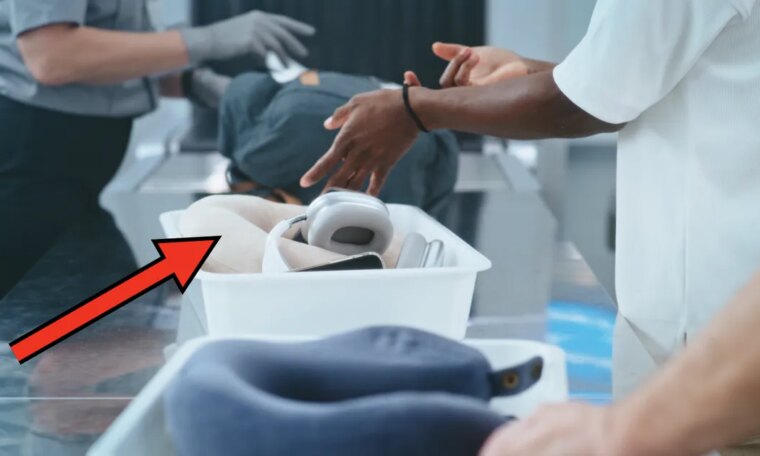
7. Headphones, glasses and neck pillows
A study published in an infectious disease journal found that TSA bins are among the germiest places in airports. Bins may be touched by thousands of people a day, and they are rarely cleaned.
For that reason, “if it touches my skin, it’s not going in the bin,” said Christine Phillips, the founder of travel agency BonVoyage Christine.
Phillips advised against putting items like neck pillows, headphones, glasses or any other item that makes contact with your body in the TSA bin. “I always stick them in my backpack or purse and close my bag before putting my bag in the bin,” she said.
As a general guideline, “don’t wait until you’re standing at the machine to organize yourself,” Burnett said. “The most efficient travelers pre-pack for security while still in line. The TSA bin should be for jackets, larger electronics and bags, not your whole personality in loose pieces.”
If you nevertheless lose an item at a TSA checkpoint, the TSA has a Lost and Found that you can contact via an online form. However, it’s better to be proactive since the TSA never finds some items, and it can be time-consuming to get back the items they do find.
Source link
CHECK OUT: Top Travel Destinations
READ MORE: Travel News