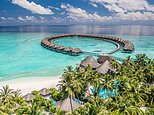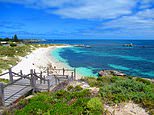

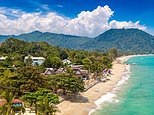
A greyscale sky is showing signs of life over slumbering waves, with sunshine breaking through clouds that had earlier brought steamy tropical rain to the north-east coast of Koh Samui.
Thailand’s second-largest island has been a tourism hotspot since the backpacker boom of the 1980s. It offers a dizzying array of experiences: quiet jungle trails, ornate Buddhist temples, energetic nightlife and a vast fringe of beaches.
It’s famously the place from which to attend raucous full moon parties on nearby Koh Phangan – nights in neon, a haze of bucket cocktails and fire dancers.
But I want to see what the island is like and what you can do when the crowds have thinned, the prices have dropped and the beaches are home to locals.
The destination is enjoying something of a renaissance. Koh Samui has been named one of Expedia’s ‘hottest islands to visit’. The travel giant says interest is up 55 per cent year on year.
Well, affordability is a big factor. I see it plainly when trying to hand over THB 100 (£2.35) for a pot of coconut ice cream scattered with peanuts, expecting it to be about right, yet the price is a mere THB 20 – just under 50p.
My guide Irene, who is taking me along the eastern coast – from honking mopeds and pulsing bars in Chaweng to the palm-draped headlands of Lamai and peaceful fishing hamlets beyond Hua Thanon – explains the quieter it gets, the more likely you are to snag a ‘locals’ price.
It’s in food that affordable Samui shines. The fundamentals of Thai cuisine – balancing punchy spices, zingy citrus, sweetness and saltiness – are easily found.
Thailand’s second-largest island has been a tourism hotspot since the backpacker boom of the 1980s (pictured: Lamai Beach)
Temple run: Ben at Wat Plai Laem in Koh Samui – thankfully without the crowds
Wat Phra Yai, known in English as the Big Buddha Temple, is located on Koh Phan, a small island offshore from the northeastern area of Koh Samui
With rain thrumming outside (not uncommon in the off-season), a huge portion of massaman curry for £7 – heavy with cardamom, cinnamon and cloves – soothes feelings of a wash-out.
If you seriously want to save, opt for street food. Bigger towns such as Nathon and Chaweng have no end of options, with banana-leaf parcels filled with sticky coconut rice unlikely to cost more than £1.
It’s even cheaper if you go for protein-packed silkworms.
One evening, an Australian expat tells me over a beer that portions definitely get bigger when there’s less of a frenzied crowd to feed outside of peak season. But it’s not just what’s going into your mouth that keeps costs low.
According to Expedia, September, the start of the rainy season, is among the cheapest months to visit, with stays often 40 per cent cheaper than December, the most expensive period to visit (though prices drop in January and February, too).
Looking to September 2026, a night at InterContinental Koh Samui Resort could cost as low as £282 B&B. The same booking for the next week would be £393.
Meanwhile, at Tui Blue The Passage I could book a double room for September next year for an extremely reasonable £107, while countless other spots are from £50.
I visit Wat Phra Yai, or Big Buddha Temple. Without the hordes, you can get close to the resplendent 40ft (12m) statue without difficulty; ditto the striking 18-armed Buddhist icon watching over the calm water at Wat Plai Laem.
Be sure to order a pot of coconut ice cream – a surprising steal at only 50p
It’s in food that affordable Samui shines, says Ben – where the fundamentals of Thai cuisine are easily found
According to Expedia, September is among the cheapest months to visit the Thai holiday hotspot
At Wat Plai Laem, it’s quiet as Ben gets close to Cundi, a diety also known as ‘Guanyin with eighteen arms’
Heading south, I am able to watch the Na Muang Waterfalls peacefully cascade without influencers in contrived poses clogging the violet-hued setting.
Day trips to remote islands are easily arranged. I spend a sun-drenched day on Koh Tao, 90 minutes from Samui by speedboat, most of it bobbing in the warm water. Here, the biggest crowds are the shoals of vivid fish darting beneath your feet.
I end the day back on Samui, watching the sunset with chilled Chang beers at a bar in Chaweng.
As the hours pass, revellers fill the street, drawn by techno and cheap drinks.
Samui offers a dizzying array of experiences: quiet jungle trails, ornate Buddhist temples, energetic nightlife and a vast fringe of beaches.
The destination is enjoying something of a renaissance, with Koh Samui named one of Expedia’s ‘hottest islands to visit’
Even when it gets quieter, Samui never feels dead – a comment I make to the woman pouring my lager.
She tells me the community might need tourists to keep the economy going, but the quiet months allow locals to catch their breath and enjoy themselves.
And even with the higher chance of rain, the island is a winner – and allows visitors to catch their breath, too.
Source link
CHECK OUT: Top Travel Destinations
READ MORE: Travel News