

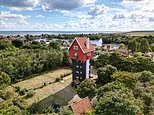
With holidays abroad at risk, and two million seats axed from May flights more people than ever are seeking a UK staycation.
While it’s probable the big name attractions will come to mind when you think of where to go – Big Ben, Buckingham Palace, Stonehenge and the like – there are plenty of other more unusual sites across the country.
In fact, venturing off the beaten track could take you to some intriguing – and sometimes utterly absurd – destinations.
From a pyramid made out of granite to a Victorian tourist attraction inside a cave and a ‘house in the clouds’, the UK is home to some weird and wonderful delights.
The attractions feature in a new book Weird Guide by Dave Hamilton – published by Wild Things Publishing, and available to buy now.
Here’s a rundown of some of the most bizarre for you to peruse…
Lost Gardens of Heligan, Mevagissey, Cornwall
The first attraction on the list is the fox statue at the Lost Gardens of Heligan, Mevagissey
The Lost Gardens of Heligan, Mevagissey – in Cornwall – are some of the UK’s most popular gardens, and they are also home to some unconventional outdoor attractions.
Previously owned privately, the house found here also served as a base for American troops during the Second World War.
After this point, the gardens fell into disarray – that is, until the 1990s, when volunteers and staff worked to refurbish them.
Nowadays you can visit the garden’s exhibits, ranging from a Mud Maiden, a ‘living’ moss-covered statue of a woman lying in the earth, and a giant 6m (19.7ft) sculpture of a leaping fox carved from a 150-year-old red rhododendron.
Fairy Glen, Uig, Isle of Skye
Next up is the Fairy Glen, in Uig on the Isle of Skye
The Fairy Glen, located on the Isle of Skye, may not actually have any attached mythology – but that doesn’t make it any less magical.
The green hills and jagged landscape were created by an ancient landslip – and have been smoothed down to create this mystical glen.
It’s more than just ancient, too – it dates back more than 100,000 years.
Rock House, Kinver Edge
Rock House at Kinver Edge was formed 250 million years ago
If you think 100,000 years is old, just wait until you see this – a rock-carved house that was formed 250 million years ago, when England was still underwater and located much further south.
Over time, the structures were converted into homes – and are now owned by the National Trust.
The caves act as a living museum and display what life would have been like inside them, with fireplaces and dramatic views to discover.
Kelvedon Hatch Nuclear Bunker, Essex
Kelvedon Hatch Nuclear Bunker joins the list of unusual attractions
Kelvedon Hatch Nuclear Bunker was built to cope with any potential attack during the Cold War – and has space for 600 military personnel, civilians and a Prime Minister.
From the outside, it looks like an ordinary bungalow.
But once you follow the tunnel underground to the three-storey bunker, it’s a different story.
It’s the size of 33 ordinary UK homes, and is home to one of the largest Cold War museums in the world, with living quarters, an office space, a BBC studio, a kitchen and a medical room.
Little Italy, Gwynedd, North Wales
Little Italy is a group of structures built by chicken farmer Mark Bourne, in Gwynned, North Wales
Italy-mad chicken farmer Mark Bourne had one aim: to recreate the beauty of his favourite country in his home.
The little Italy collection of more than 30 landmarks features a 6ft Rialto Bridge from Venice, a mini Duomo from Florence and a smaller version of the Leaning Tower of Pisa.
It was crafted over 25 years by the late farmer and his wife Muriel next to their 19th-century cottage in Gwynedd, North Wales.
Prince Albert’s Pyramid, Balmoral is next up on the list
When you see pyramids, it’s likely Egypt is the place that first comes to mind.
But at 41 feet high, Albert’s Pyramid was commissioned by Queen Victoria to commemorate the death of her husband.
Situated in Balmoral in Scotland, it dates back to 1862.
The Balmoral Pyramid, known as Prince Albert’s Cairn, is surrounded by countryside and is one of 11 structures built to represent the life of Queen Victoria and her descendants.
Margate Cave
Margate Cave was once a popular Victorian sightseeing attraction
A network of chalk caverns can be found underneath Margate’s Northdown Road – and they were once a highly popular Victorian tourist attraction known as Vortigern Caves.
They have been subject to many myths and legends, including a ‘fake news’ story from 1863 claiming a man stumbled upon them by accident when the ground gave way and he fell inside.
Nowadays, you can visit, with tickets from just £2.50 – and discover the previously abandoned chalk mines adored by visitors in days gone by.
House in the Clouds, Thorpeness, Suffolk
One of the UK’s most bizarre attractions is the House in the Clouds
The House in the Clouds, originally built as a water tower in 1923, was designed to blend in – a goal which, these days, clearly fails.
But after the 1980s, it stopped working as a water tower, and was converted into a real house.
Nowadays, you can even rent the five-bedroom property on Airbnb from £700 a night.
It’s described as ‘a truly unique place to stay, one of England’s most famous follies’.
A house for Essex, Manningtree
A house for Essex in Manningtree is certainly not a conventional British property
A House for Essex – with its geometric design, gold roof and red door – hardly blends into the scenery.
It was created by the artist Grayson Perry and architect Charles Holland for Living Architecture, a company founded by philosopher and writer Alain de Botton in 2006.
The aim? To create magnificent holiday homes that pay homage to modern architecture – and it absolutely succeeds.
Perry said: ‘How alien it looks in the landscape yet at the same time it also fits in.’
Lennox Castle, Kirkintilloch, Scotland
Lennox Castle, situated in Kirkintilloch, Scotland rounds out the list
Lennox Castle, built between 1837 and 1841, was turned into a hospital for people with learning disabilities with around 1,200 residents.
However, by the 1980s it fell into disarray, with negative reports swirling around the institution – some even suggesting patients were malnourished.
It closed by 2002 and was further damaged in 2008 by a fire.
Weird Guide takes you on a journey through some of the UK’s most bizarre attractions
Source link
CHECK OUT: Top Travel Destinations
READ MORE: Travel News