

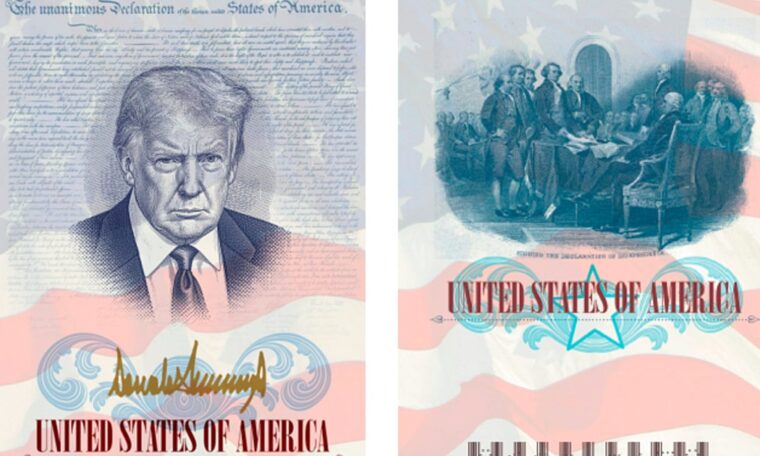
News of a special edition passport prominently featuring President Donald Trump’s face quickly sparked criticism and confusion.
On Tuesday, the State Department shared images of a new commemorative version of the travel document, supposedly tied to the country’s upcoming 250th anniversary. Mockups of the design show a picture of Trump superimposed over the Declaration of Independence and his signature in gold ink underneath ― prompting a wave of mockery, outrage and memes.
And it’s not just political observers and social media critics who have expressed concerns around the news. Experts in the realm of passports ― from historians to travel logistics specialists ― noted that the new document displays a striking break from tradition.
“This is entirely novel,” said Patrick Bixby, a professor of humanities at Arizona State University and author of “License to Travel: A Cultural History of the Passport.”
“There are no precedents that I’ve come across, not even in authoritarian regimes ― Stalinist Russia or Maoist China. It would be a real departure from the typical design considerations of the U.S. passport and passports globally to put the image of a sitting head of state anywhere within the document.”
This rendering provided by the State Department shows an example of the limited-release commemorative U.S. passport the department is preparing in honor of America’s 250th birthday.
Passports, he noted, are “inherently patriotic documents,” but that patriotism has historically been expressed through shared national symbols.
“The U.S. passport undergoes periodic redesigns, and the last few iterations contained a variety of historic images, iconic landscapes, national landmarks and the like ― images that are attached to the nation and its history, not to any single administration or political party or individual,” Bixby said. “It would be unusual for a living individual who’s active on the political scene to be displayed there.”
That distinction matters not just because of tradition but because of the practical function of passports globally.
“When you hand that to passport control officers at airports around the world, you are presenting an image of your national identity,” he explained. “To tie that so closely to one individual ― especially such a divisive figure and one so deeply unpopular in other parts of the world ― seems like an odd choice.”
While many details about the proposed limited-edition passport remain unclear, the announcement has already raised questions about logistics, the Trump administration’s priorities and what a passport is supposed to represent.
What makes this passport so different?
“In my view, this has the hallmarks of a classic Trump spectacle,” said Tom Topol, an author and historian who specializes in passport history. “The irony is that a thoughtfully-produced 250th anniversary commemorative passport could genuinely be a remarkable idea, one worth celebrating. As conceived here, however, it risks becoming a collector’s curiosity defined more by controversy than by the history it purports to honor.”
He noted that several countries, including the U.S., have issued commemorative passports in the past. There was the 1976 U.S. bicentennial passport, which featured a Liberty Bell pattern on the interior pages and a star emblem on the back. And between April 1993 and March 1994, the U.S. issued an estimated 4.2 million special green passports to honor Benjamin Franklin and the 200th anniversary of the U.S. Consular Service.
The Trump-focused semiquincentennial passport appears to be a smaller in scope, with the State Department reportedly planning a “limited run” of 25,000 booklets.
“This would be extraordinarily unusual,” Topol said. “There are no true precedents for something on this scale. A print run of just 25,000 copies would place it in an entirely different category from previous U.S. commemorative editions, which were limited in relative terms but still issued in the millions.”
As an expert in passport history, Topol emphasized that passport design has always served as an expression of national identity and sovereignty.
“Traditionally, that means landscapes, inventions and historical figures that citizens can recognize and take pride in,” he explained. “Current figures are essentially never featured, and geopolitical statements are inherently contentious.”
“
Now Trump’s face is layered over the Declaration of Independence, obscuring the text of that document as if his image is more important.
– Patrick Bixby, professor of humanities at Arizona State University
Topol pointed to some “instructive examples” of the backlash against passport redesigns, particularly ones that seem to make a statement.
“China’s 2012 passport redesign embedded a watermark map depicting the disputed nine-dash line in the South China Sea, alongside territories like Arunachal Pradesh and Aksai Chin, prompting formal protests from Vietnam and the Philippines, with Vietnam refusing to stamp the passports outright,” he said. “Canada’s 2023 redesign removed beloved historical imagery, including Terry Fox and the Vimy Ridge Memorial, replacing it with nature scenes. Veterans and politicians decried it as an erasure of national heritage.”
Norway’s minimalist 2014 design also initially drew criticism for departing “too sharply from convention,” he added.
“The current standard passport interior cover design depicts artwork of ‘The Star-Spangled Banner’ by Edward Percy Moran, which shows Francis Scott Key, who wrote the U.S. national anthem’s lyrics pointing at the American flag flying over Fort McHenry [in] 1814,” said Madison Blancaflor, managing editor of The Points Guy. “The opposite page currently features a quote from Abraham Lincoln highlighting the U.S. as a ‘government of the people, by the people, for the people’ with the U.S. seal and a declaration in English, French and Spanish.”
Travel writer Rocky Trifari sees the new commemorative design as shifting the focus of passports away from universal recognition and consistency across borders and toward political expression.
“The front cover normally reads ‘PASSPORT’ at the top and “United States of America” written smaller at the bottom,” he said, noting that the Trump version reverses this with ‘UNITED STATES OF AMERICA’ in a larger font at the top and a smaller ‘PASSPORT’ at the bottom.
“That reversal aligns with his reputation for extreme nationalism and an ‘America First’ ideology, but arguably detracts from the document’s actual purpose ― to be recognized as a passport first and foremost,” Trifari said.
Meanwhile, Bixby was struck by the choice of portrait of the president and compared it to the president’s mug shot following his arrest on felony charges related to his efforts to overturn the 2020 presidential election results.
“He’s kind of glowering ― it’s not a very friendly look on his face, which seems like a strange choice,” he said. “It’s a cliche that our passports always contain a photo of ourselves that we don’t like very much, because you can no longer smile in those photos, can’t wear your glasses and have to be as plain as possible. And now Trump’s face is layered over the Declaration of Independence, obscuring the text of that document as if his image is more important.”
He also took interest in the “limited-edition” framing of the passport, turning this government-issued travel document into a sort of consumer product.
“There are nations around the world that provide citizenship by investment, issuing a passport if you buy land or pay a certain amount of money to the government or whatnot,” Bixby said. “And this kind of thing, which would allow you to ingratiate yourself to the Trump administration or display your political affiliations as you travel around the world, is a particularly strange instance of this general pattern of putting his name and likeness on things.”
Indeed, the president has taken to adding his name, face and signature to a growing list of items.
The National Park Service’s annual pass now features a picture of Trump ― and a new policy voiding passes with stickers that cover his face. The U.S. Commission of Fine Arts recently approved a 24-karat gold commemorative coin with his image ahead of America’s 250th birthday. Massive banners with the president’s face now adorn several government buildings in the nation’s capital as well.
Graeme Sloan/Bloomberg via Getty Images
A banner depicting President Donald Trump at the Department of Justice on Tuesday, April 7, 2026.
The passport redesign falls under the authority of Trump’s State Department.
“Of course, it’s very much in line with a number of other decisions in the last 15 months or so to put Trump’s name on all manner of things where it probably doesn’t belong,” Bixby said. “This kind of complicity with Trump’s ego trip is a little bit unsettling ― and particularly unsettling in this regard because this is a document that you take abroad.”
Although passports are government-issued documents, he believes there is a personal element to them as well.
“Your passport includes your personal information and stamps that tell us something about where you work, where you vacation, the kinds of people you want to come into contact with,” Bixby said. “So to hijack the document for what seems like, if not overtly egotistical, overtly political reasons, you’re placing a particular head of state with his party affiliation and policies front and center in a document that’s going to travel around the world with the holder. And it’ll be presented potentially to governments that aren’t sympathetic to the Trump administration.”
This commemorative edition would not be the only change the current president has made in the U.S. passport realm.
“Recently, during the 46th President Biden administration, a surprise and immediate printing of new passport applications was made to reflect the applicant’s desired option of sex: M, F, or X,” said David Alwadish, the founder and CEO of the passport and visa concierge service ItsEasy.com.
“During the 47th President Trump administration, the Sex by Applicant Choice option on passport was disbanded and all related applications destroyed,” he added. “New to the new passport application DS-11, during this administration, [was] the addition of a unique identifier, if applying for first time after naturalizing, assigned to those who have engaged with the U.S. immigration system.”
So how can Americans be sure they get — or avoid — one of these passports?
Exactly how Americans would obtain one of these passports ― or avoid getting one ― remains one of the biggest unanswered questions.
“While there are mockups of the new design circulating online, no official releases have been issued by the State Department about when exactly these new passports will start being issued or the formal process for obtaining one,” Blancaflor said. “There’s a lot still up in the air about how this limited-edition passport rollout will work.”
Thus far, the State Department has told media outlets that the Trump commemorative passport will be the default passport option at the Washington Passport Agency in D.C. while supplies last.
“I believe the rollout will be exclusive and limited to that location, meaning that most people will not receive this version unless they are local or intentionally visit that specific agency,” Trifari noted.
What we do know for sure is that the announcement has already sparked strong reactions.
“I am confident that there will be strong public passion both for wanting to have one of these limited-edition celebratory passports, and for not wanting one of these new passports,” Alwadish said.
He predicts a more controlled, opt-in process for the commemorative passports.
“Based upon my experience, those applicants simply wanting to replace their current valid passport solely for an opportunity to get the new design passport, will be able to submit their passport for an early renewal with a DS-82 application, request the new 250th year passport and pay the full renewal fee,” Alwadish said. “I expect the issuance of this passport will be by an actual documented request during the passport application process, very much like requesting a thicker 52 page passport, vs. the traditional 26 page passport, once availability is announced.”
If you need to renew yours soon, remember, timing is crucial. Many destinations require visitors to have a passport that is valid for three or six months beyond the date they intend to depart.
“If you have strong feelings about which passport version you receive and don’t have international travel plans within the next six months, you can always wait a few weeks until more details about these limited-edition passports are unveiled,” Blancaflor said. “That way, you can make a more informed decision about how you go about applying or renewing your passport. With a trip that far out, waiting a few weeks shouldn’t negatively impact your ability to get a passport on time.”
If you’re headed out of the country in the next few months, however, you might not want to wait.
“Passports typically take four to six weeks to process,” Blancaflor said. “Having a valid passport for your travels is ultimately more important than the design on the inside cover. Plus, those who wish to have the standard passport can apply at another passport agency location or go through the online renewal process if eligible.”
Source link
CHECK OUT: Top Travel Destinations
READ MORE: Travel News


