

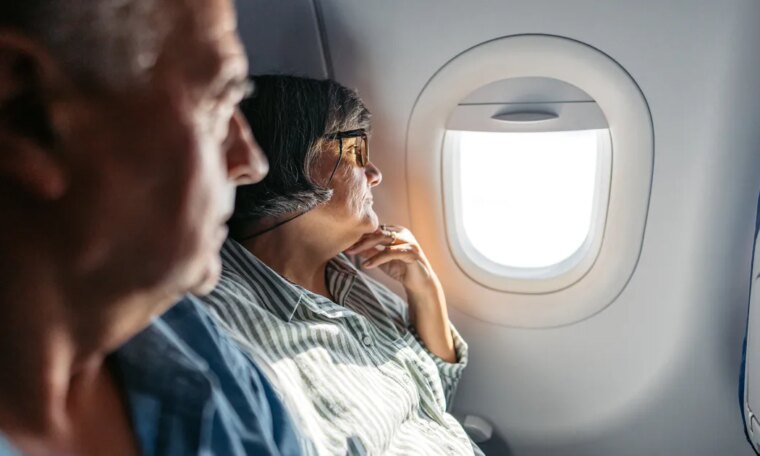
If you’ve flown enough times, you’ve probably experienced this situation at some point. It’s an early morning or red-eye flight, so you’re trying to get a little sleep. Suddenly, someone in your vicinity raises the window shade, and blinding sunlight hits your eyes, waking you up and making it nearly impossible to fall back asleep. Or maybe you’re the window seat passenger on a long afternoon flight, minding your business with the shade open, when the person next to you silently ― and without asking ― reaches over and slams it shut.
Who actually has the right to control the window shade? And how should passengers handle these situations?
HuffPost asked experts to weigh in on the etiquette around airplane window shades and best practices for air travelers.
“Since you are on an airplane, first and foremost you must comply with crew instructions,” Jodi R.R. Smith, the president of Mannersmith Etiquette Consulting, told HuffPost. “Many airlines will instruct passengers to keep the window shades over the wings up for takeoff and landing.”
There are indeed safety considerations during those two phases of the flight. Because most aviation incidents occur during takeoff and landing, many airlines and aviation authorities require open window shades at these times to allow crew and passengers to assess outside conditions in an emergency and keep everyone’s eyes adjusted to the natural light in case of an evacuation.
That’s why crew instructions take priority over passenger dynamics.
“Flight attendants call the shots first and foremost,” said Thomas Farley, aka Mister Manners. “If a shade has to be raised or lowered, especially during takeoff and landing, passengers should abide by those instructions.”
But what about the cruising portion of the flight? Assuming crew requirements are met, the window seat passenger is next in the line of power over the window shade. So if that power is important to you, try to book early enough to choose that particular seat for yourself.
“Whether because they want to sleep with their head against a closed window shade or because they want to peer at clouds for nine hours, the window-seat passenger has sole discretionary power to determine the position of the shade,” Farley said. “By no means should an aisle passenger or a middle-seat passenger in a fully occupied row assume shade control.”
But that doesn’t necessarily mean absolute authority.
“If you are the passenger seated by the window, you generally have the privilege of controlling the window shade,” said Jackie Vernon-Thompson, the founder of From the Inside-Out School of Etiquette. “However, good etiquette reminds us that having the right to do something does not eliminate the opportunity to be considerate of others.”
Viktor Cvetkovic via Getty Images
Window seat passengers should be open to reasonable requests from their rowmates regarding the shade.
She suggested extending a simple courtesy before opening or closing the window shade if you see the change could affect your rowmates.
“Simply ask, ‘Do you mind if I open the shade?’ You are not asking for permission or giving another passenger control over your decisions,” Vernon-Thompson said. “You are simply acknowledging that your actions can affect their comfort as well. More often than not, when you extend that courtesy, the response will be, ‘Not at all.’”
Not every shade situation is the same, and etiquette experts say context should guide your call.
“On an overnight flight, lower the shade,” said Nick Leighton, an etiquette expert and host of the “Were You Raised by Wolves?” podcast. “On a short daytime hop, most people probably won’t mind the sunshine.”
Smith pointed to a few specific scenarios worth thinking through for a moment.
“For flights at sunrise or sunset, the angle of the sun can be quite blinding. If the sun is a bother to others, the shade should be down until the sun is no longer a danger,” she said. “For long-haul flights, where the sun is shining brightly where you are but not at your destination, the shades should be down when the crew dims the cabin lights to allow passengers to rest.”
There are climate considerations as well.
“For warm climates, the shades should be down until the plane is in motion or the plane arrives at the gate. This helps to keep the interior as cool as possible before takeoff and for the next passengers,” Smith said.
Typically in these situations, the crew makes a specific request, so the onus is removed from the passengers.
“During cruising portions of the flight, shades are often left to passenger discretion,” Yuvraj Datta, the chief supply and revenue officer at the travel tech company Fareportal, told HuffPost. “Crew members may occasionally ask passengers to lower shades for operational reasons, such as reducing cabin temperatures during ground delays, minimizing glare on flight deck instruments, or improving comfort for passengers during long-haul flights.”
But in the absence of crew instructions, just use your best judgment. Keeping the shade down when the cabin is dark and people are sleeping should feel like the obvious choice when it’s light outside and not yet time to land.
“Could you open it? Certainly. However, as a kind and considerate passenger, you might choose to wait until they awaken, especially if you have no immediate need to open it,” Vernon-Thompson said. “That is not allowing another passenger to control your actions. That is consideration.”
And if the window seat passenger doesn’t automatically make the considerate choice, the middle and aisle seat folks do have recourse.
“The window passenger gets to pick the initial setting, but if the middle passenger asks you to lower your shade because they’re trying to watch a movie or get work done on their laptop and the sun is creating a lot of glare, that’s a reasonable request,” Leighton said.
Smith agreed and offered some polite language for making that request.
“‘I’m so sorry to ask, but with the angle of the sun, I am having a hard time reading my Kindle. Would you be so kind as to pull down the shade?’” she suggested saying. “As with all other interpersonal interactions, people must consider how their behavior impacts those around them. A bit of consideration goes a long way.”
Different considerations may arise depending on the specific flight timing and other factors.
With that in mind, the person sitting in the middle or aisle seat should not intrude on the window seat passenger’s space.
“It would be impolite to reach across the passenger seated nearest the window and adjust the shade yourself,” Vernon-Thompson said. “Reaching into another passenger’s personal space can feel intrusive and unnecessarily uncomfortable. Instead, simply ask, ‘Would you mind closing the shade, please?’ The passenger seated by the window can then graciously respond to your request.”
If no one is sitting in the window seat, the person in the middle gains control over the shade. And then, of course, the aisle passenger if there’s no one in the window or middle.
There are some less clear-cut situations as well.
“As most passengers know, the windows rarely line up exactly with the seats,” Smith said. “This means the two window seat passengers sitting directly in front of and in back of each other may need to negotiate. For most flights, the passenger who has the majority of the window usually decides, but this is hardly a rule.”
She urged those who like to sleep on airplanes to travel with an eye mask in order to assume some control over their own comfort rather than depending on shade negotiations going their way.
Leighton pointed to an obvious but often overlooked middle ground.
“Shades can also be half-lowered. It isn’t all or nothing,” he said.
He also offered an important reminder for all air passengers: “Nobody ‘owns’ anything on an airplane. Teamwork makes the dream work.”
As with all aspects of air travel etiquette, it’s helpful to keep the bigger picture in mind.
“Whether you are seated beside someone for a 90-minute flight or several hours, courtesy, kindness and consideration should always accompany the journey,” Vernon-Thompson said. “No one needs to be demanding, territorial or inconsiderate. Shared spaces require shared courtesy. Etiquette is not always about what we can do. Sometimes, it is about recognizing how what we do may affect the people around us.”
Source link
CHECK OUT: Top Travel Destinations
READ MORE: Travel News