

Warmer seas are bringing the potentially dangerous Vibrio bacterium closer to European beaches, prompting health warnings as millions of tourists head to the coast this summer.
The combination of record-high sea temperatures and overwhelming tourist numbers is driving up coastal pollution.
As a result, a growing number of beaches across Europe are seeing health alerts and sea access bans.
And, according to Hatim Aznague, a climate analyst at the Union for the Mediterranean, the Med is ‘one of the fastest-warming seas on the planet’, making it a hotbed for harmful bacteria.
Speaking to Euronews, he added: ‘Warmer water, especially where it is less salty, at river mouths and in the lagoons they enclose, becomes more conducive to pathogenic bacteria.’
Most Vibrio bacteria are harmless, but strains such as Vibrio vulnificus can cause serious infections if they enter the body through open wounds, which is why it’s commonly referred to as the ‘flesh-eating bacteria’.
In rare cases, they can lead to necrotising fasciitis, sepsis, amputations or even death, particularly in people with weakened immune systems or liver disease.
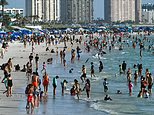
Experts are warning beachgoers of a flesh-eating bacterium named Vibrio vulnificus that is spreading in seas across across the world, with Florida (pictured) being a hotbed for infections
Due to rising sea temperatures, many beaches across Europe are seeing health alerts and sea access bans.
The European Food Safety Authority (EFSA) says Vibrio can also contaminate seafood, while the European Centre for Disease Prevention and Control (ECDC) warns infections become more likely during summer heatwaves and in shallow coastal waters.
In 2025, Vibrio vulnificus led to a significant number of hospitalisations and fatalities, particularly along the US Gulf and East Coasts.
In Florida, health officials confirmed 29 total cases and at least 5 deaths, while Louisiana saw an unusual surge, reporting 26 hospitalisations and 5 fatalities.
One such case is a Florida mother who was left fighting for her life after contracting Vibrio vulnificus at a popular Pensacola beach.
Genevieve Gallagher, 49, almost lost her leg after she was infected with vibrio vulnificus, which she’d contracted while swimming at Quietwater Beach along the Santa Rosa Sound on July 27, 2025.
And just this month, a Florida teenager has been left fighting for his life after contracting the deadly flesh-eating bacteria that he caught after swimming at his local park.
Joziah Thompson’s mother had warned him about the cut on his lower left leg but the 17-year-old thought nothing of it when he went for a swim off Florida’s Northwest coast, near Pensacola, with his siblings.
But just days later, fever and pain ensued, and he was rushed to the hospital, where doctors diagnosed him with a Vibrio vulnificus infection. He is now undergoing surgery and taking aggressive antibiotics to help fight the infection.
As for Europe, Germany saw its first fatality of the summer bathing season in July 2025, when a 68-year-old with underlying health conditions contracted the bacteria.
Pictured: Flagellated Vibrio vulnificus bacterium revealed in the 26367x magnified scanning electron microscopic
Pictured: 17-year-old Florida native Joziah, who is currently fighting for his life after contracting a severe Vibrio vulnificus infection
Pictured: The wound in which the bacterium entered on Joziah’s leg
Pictured: Genevieve Gallagher, who contracted Vibrio on a Florida beach in July 2025
In light of this, scientists say the Mediterranean is warming around 20 per cent faster than the global ocean average.
Although the region’s naturally salty waters have historically limited the most dangerous Vibrio strains, experts warn that rising temperatures and changing salinity could allow the bacteria to spread further.
To reduce the risk of Vibrio infection, experts at the ECDC advise to cover open wounds with waterproof bandages while swimming in coastal or brackish waters – or stay out of the water entirely if unable to do so.
Always wash your hands and any skin that touches seawater, and for those who enjoy seafood, it might be best to avoid eating raw or undercooked shellfish.
The growing presence of Vibrio also poses a threat to Europe’s tourism industry.
Aznague further warned that beach closures come with both an immediate financial cost and long-term damage to a destination’s reputation.
He added: ‘On our coasts, the shoreline is not part of the economy; it is the economy… A closed beach is a climate impact that comes with a bill attached.’
With Europe welcoming 747 million international tourists in 2024, disruption to popular coastlines could have significant economic consequences.
EFSA also warns that rising temperatures, extreme weather and antimicrobial resistance in some Vibrio strains are increasing public health risks.
Aznague says greater international cooperation is needed, arguing the ‘bacteria are not the story; they are the messengers. The story is a sea thrown out of balance by heat and pollution’.
Meanwhile, those looking cool to off at beaches closer to home over the summer are warned of 20 no-go hotspots that are rife with contaminated waters, sewage and dumped waste polluting the sea.
There are 20 stretches of English coastline that have been classified as ‘poor’ for water quality, according to travel site Locals Insider.
This is the lowest rating issued by the Department for Environment, Food and Rural Affairs (Defra) – and means swimming is not recommended.
Here’s a rundown of the no-go spots…
Source link
CHECK OUT: Top Travel Destinations
READ MORE: Travel News